
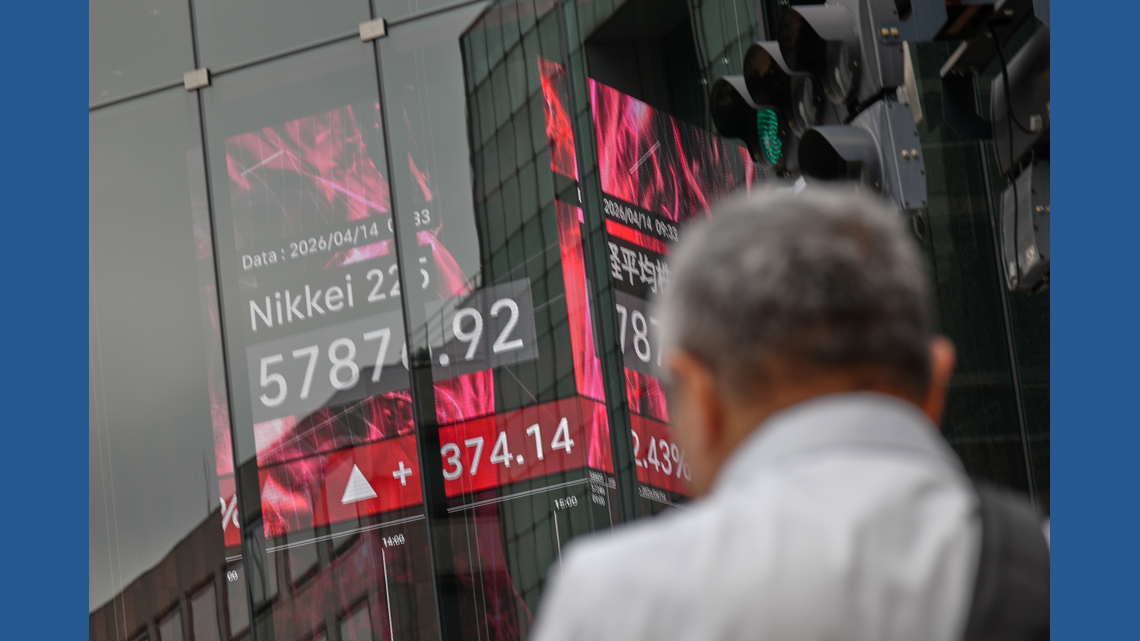
Asian equities rallied on hopes of a second round of U.S.-Iran talks, with the Nikkei up 2.4%, Kospi up 3.4%, and the Shanghai Composite up 0.6%. Oil prices retreated as Brent fell 1.3% to $98.12 a barrel and U.S. crude dropped 2.2% to $96.92, while gold rose 0.6% to $4,796.60 and silver gained 1.8% to $77.05. The backdrop remains highly volatile as the Iran war enters its seventh week, the U.S. military blocks Iranian ports, and investors weigh inflation risks from Strait of Hormuz disruptions.
The market is pricing a fast de-escalation path, but the bigger signal is not the level move in crude — it is the volatility collapse that follows any credible ceasefire headline. That setup tends to favor short-dated risk assets with high beta to lower input costs, while punishing the crowded “war premium” expression in energy, defense-adjacent, and inflation-hedge positioning. If talks progress, the first-order beneficiary is not just cyclicals: it is duration-sensitive growth, Japan/Korea exporters, and rate-cut-sensitive sectors that have been held back by the inflation impulse from shipping disruptions.
The real second-order risk is that this becomes a whipsaw regime: headline-driven risk-on rallies can reverse sharply if maritime access remains impaired even after a diplomatic framework is announced. In that scenario, oil can reprice higher again without a full return to war escalation, which is worse for positioning because investors will have already rotated out of hedges. The market is therefore vulnerable to a classic “peace premium selloff” in crude that proves temporary if port restrictions, insurance costs, or convoy delays continue to keep physical barrels tighter than the headline suggests.
For Goldman, the negative reaction despite strong profits likely reflects that traders are starting to discount peak trading revenues from elevated volatility and rates, not just a one-quarter miss. If geopolitics cool and the curve softens, the less obvious loser is the broader market-structure earnings stack: commodities desks, freight brokers, and some market-making revenues tied to dislocation. That makes financials a more nuanced trade than a simple quality long; the winners are less the diversified capital-light franchises and more the names with direct linkage to underwriting, advisory, and underwriting pipeline stabilization if risk appetite improves.
AI-powered research, real-time alerts, and portfolio analytics for institutional investors.
Request TrialOverall Sentiment
neutral
Sentiment Score
0.05
Ticker Sentiment
