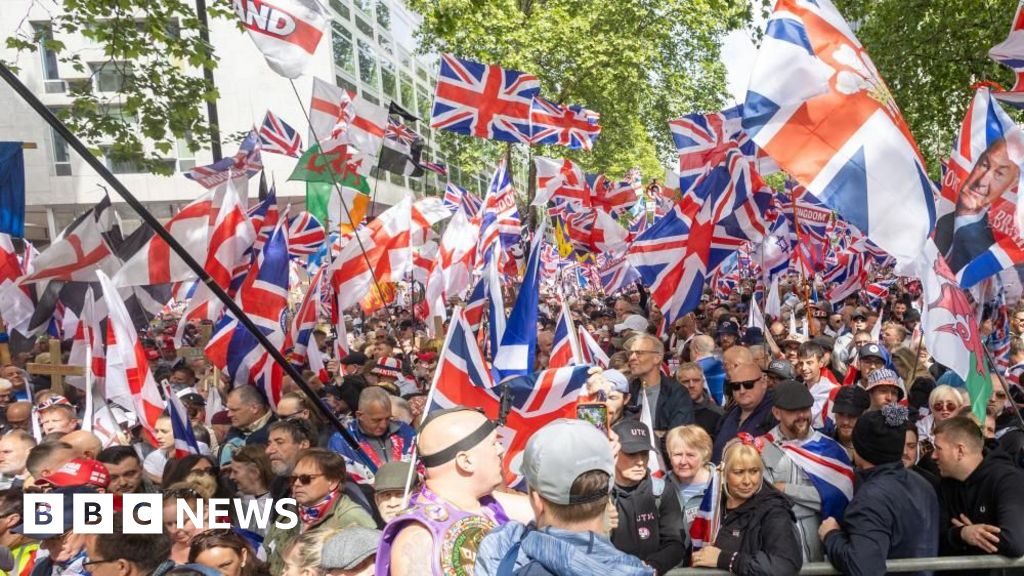
London saw tens of thousands attend rival protests, including Tommy Robinson's Unite the Kingdom march and a pro-Palestinian demonstration, prompting deployment of more than 4,000 police officers and a £4.5m policing operation. The Met used live facial recognition for the first time in a protest operation, arrested 11 people by 13:00 BST, and blocked 11 foreign far-right agitators from entering the UK. The story is primarily a domestic politics and public order update, with limited direct market impact beyond policing, legal, and security policy implications.
This is a short-horizon volatility event, but the market impact is less about the protests themselves than about the state’s willingness to widen the surveillance and prosecutorial perimeter around public dissent. The combination of live facial recognition, tighter protest routing, and faster hate-speech enforcement creates a template that can be reused for future demonstrations, raising the probability of additional civil-liberty litigation and municipal security spend over the next 3-12 months.
The second-order winner is the security stack, not the headline political side. Vendors with exposure to CCTV analytics, biometric screening, drone monitoring, and command-center integration should see incremental procurement demand from police forces and transport hubs; the larger investment implication is that temporary “event security” budgets can become recurring operational line items if public-order risk stays elevated into the summer. The loser is the reputationally sensitive transport and venue ecosystem, which now has to absorb more screening friction and policing overhead whenever large crowds converge.
The contrarian point is that the immediate market reaction should not be to assume a broad risk-off regime: the state is actively signaling capacity and control, which usually suppresses escalation after the event unless there is a policing misstep or a high-profile arrest. The real tail risk is legal overreach—if prosecutions are perceived as viewpoint-based rather than conduct-based, it could trigger court challenges, union pushback, and a media cycle that extends the story from one weekend into a policy fight.
From a geopolitical angle, this is a micro-catalyst for anti-migration, antisemitism, and Gaza-related discourse to stay elevated in UK politics into the next polling window, increasing pressure on incumbents to appear tougher on disorder. That tends to support “law and order” positioning, but it also raises the odds of more restrictive protest rules, which would be a medium-term headwind for firms reliant on public-space footfall if crowd management becomes more intrusive.
AI-powered research, real-time alerts, and portfolio analytics for institutional investors.
Request DemoOverall Sentiment
neutral
Sentiment Score
-0.05
