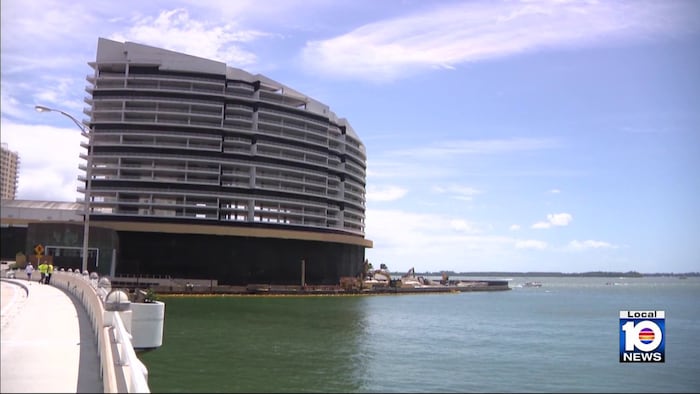
The Mandarin Oriental Miami, a 26-year-old landmark on Brickell Key, is scheduled for a controlled implosion at 8:30 a.m. Sunday, lasting about 20 seconds. The demolition is clearing the site for a larger redevelopment project, with no evacuations required and only temporary street and bridge access restrictions. This is routine local redevelopment news with limited broader market implications.
This is less a demolition story than a signal that Miami’s high-end waterfront land is still being repriced upward despite already-stretched replacement costs. The key second-order effect is that removing a long-standing, income-producing asset creates a temporary hole in local luxury hospitality supply while simultaneously de-risking a larger, denser project pipeline; that tends to favor adjacent operators and lenders with exposure to prime Brickell waterfront over the legacy owner. The market usually underestimates how quickly “iconic but obsolete” assets get converted into higher-ROIC uses when financing remains available and demand is anchored by wealthy domestic and Latin American end-users.
Near term, the event is operationally noisy but economically small; the real catalyst is the redevelopment plan, not the implosion. If the replacement product is branded luxury residential or ultra-premium mixed-use, the upside is concentrated in pre-sale velocity, construction lenders, and nearby comparables that can reprice on a scarcity narrative. The main risk is a capital market air pocket: if condo absorption slows or insurance/financing costs stay elevated, the site can become a multi-year drag rather than a value unlock, which would pressure local developers and contractors with exposed balance sheets.
The contrarian view is that the market may be too quick to extrapolate “Miami resilience” into every prime project, ignoring that the next cycle is likely more selective than the last. A controlled implosion is easy; a profitable redevelopment in a higher-rate, higher-premium environment is harder. The best trade is not on the headline event itself, but on who can monetize the land conversion versus who is forced to fund or carry it through a tougher financing backdrop.
AI-powered research, real-time alerts, and portfolio analytics for institutional investors.
Request DemoOverall Sentiment
neutral
Sentiment Score
0.00
