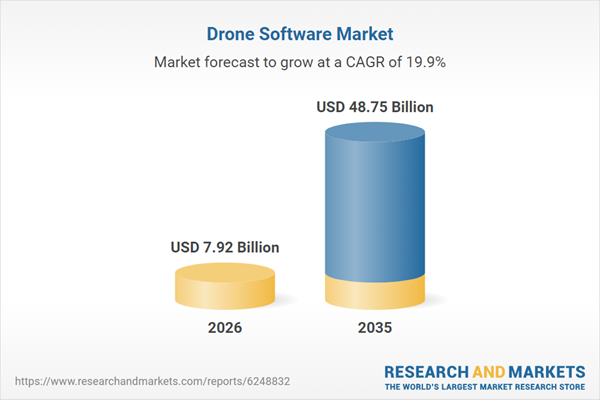
ResearchAndMarkets added a report titled "Drone Software Market" with a forecast out to 2035. The announcement provides market-research distribution details (offering, architecture, deployment, software, applications, end-users, and geography) but does not include financial results, forecasts, or company-specific guidance that would likely move prices.
This is not a fundamental catalyst; it is a packaging event around a still-undefined TAM. In public markets, research-report headlines only matter if they precede a funding round, procurement award, or guidance raise; otherwise they mostly create a short-lived narrative bid in theme baskets and then fade. The immediate winner is the ecosystem of drone autonomy, perception, and mission-planning software vendors, but only if they can convert interest into booked revenue; otherwise the benefit accrues to sell-side/marketplace vendors, not operating companies.
The second-order effect is more relevant for defense than for commercial drones: software is the bottleneck for swarm coordination, sensor fusion, and edge autonomy, so the value capture may sit with platform integrators and data-layer names rather than airframe makers. That argues for watching AVAV, KTOS, PLTR, and larger defense software beneficiaries, while being cautious on pure-play commercial drone names that remain hardware-margin constrained and capital-hungry. Any near-term enthusiasm is likely to show up first in small-cap beta and thematic ETFs, not in durable EPS revisions.
Contrarian view: consensus may overestimate how quickly a “drone software market” translates into monetizable demand. The key falsifier is the absence of incremental contract awards or backlog conversion over the next 1-3 quarters; without that, the report is just a marketing artifact. If there is a trade, it should be on evidence of procurement acceleration, not on the report itself.
AI-powered research, real-time alerts, and portfolio analytics for institutional investors.
Overall Sentiment
neutral
Sentiment Score
0.00
