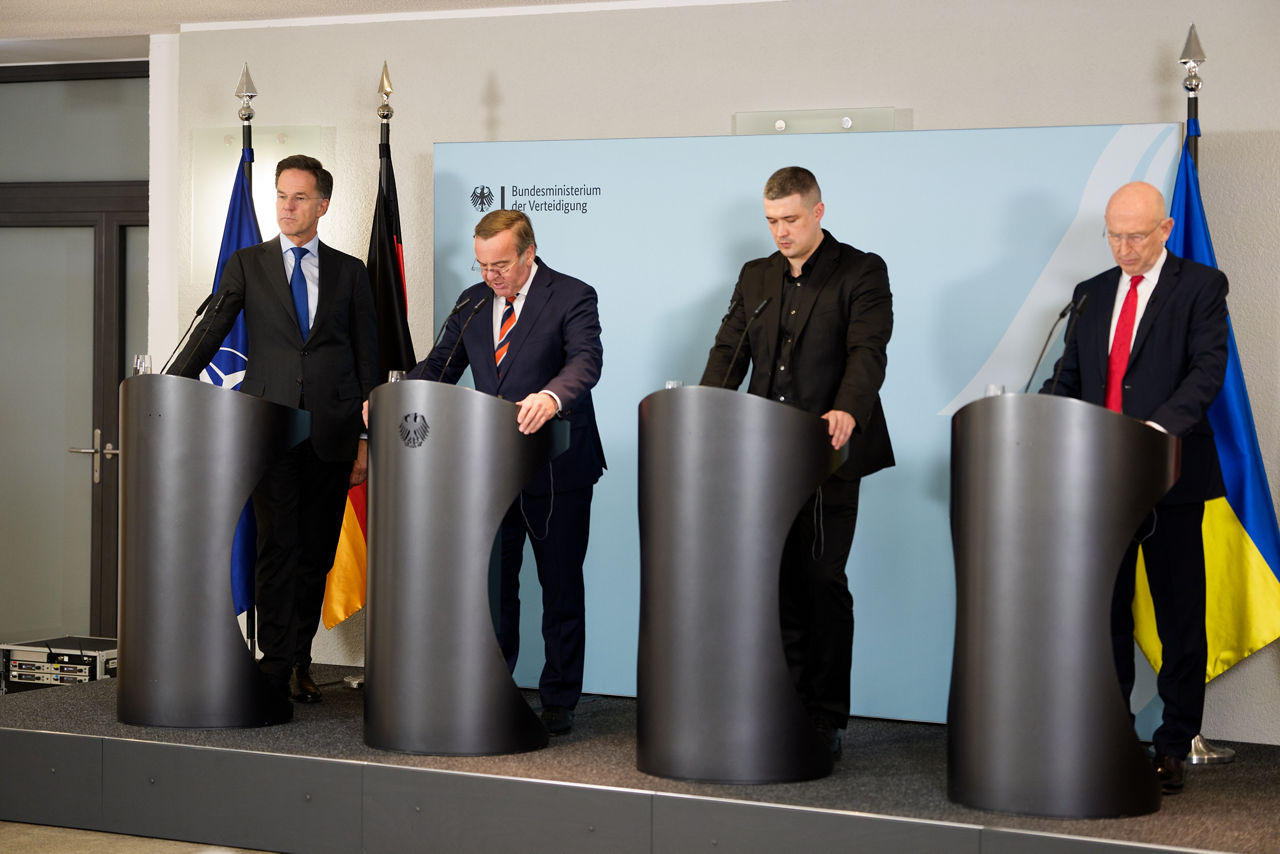
On 15 April 2026, NATO Secretary General Mark Rutte attended the Ukraine Defence Contact Group meeting in Berlin and reaffirmed continued support for Ukraine. He welcomed new contributions from Germany, the UK and the Netherlands, plus additional support for PURL and the Czech ammunition initiative. The article is primarily a routine geopolitical update with limited direct market impact.
This reads as a durability signal, not a headline shock. The important second-order effect is that continued allied coordination reduces the probability of a near-term funding air pocket for European defense procurement, which matters more for order visibility than for immediate revenue recognition. The incremental commitments to ammunition and air-defense replenishment favor suppliers with exposed backlog conversion and production scaling capacity, while penalizing firms reliant on a quick peace premium unwinding.
The cleaner beneficiaries are the European primes and munitions chain rather than the broad defense complex. Ammunition, interceptors, electronics, and logistics contractors should see the highest near-term attach rates because this type of support tends to translate into repeat orders and expedited replenishment cycles, whereas large platform programs re-rate more slowly. A less obvious winner is industrial infrastructure tied to capacity expansion—machine tools, energetics, and specialty chemicals—because allied stockpile rebuilding typically bottlenecks on throughput, not budget intent.
The main risk is that the market may already be discounting a multi-year rearmament cycle, leaving near-term upside capped unless announcements convert into funded contracts. A ceasefire or political fatigue in Europe would hit the most sentiment-sensitive names first, likely over weeks to months, while actual procurement delays would matter over quarters. The contrarian angle is that the real trade may be in the supply chain, not the headline defense names: if governments keep emphasizing ammunition and readiness, capacity-constrained inputs can outperform the primes on margin expansion and pricing power.
For positioning, this supports staying long European defense exposure on pullbacks rather than chasing gap moves, with a bias toward names levered to munitions and air defense over legacy platforms. A relative-value expression is long selected European defense suppliers versus short a broad Europe industrials basket, betting that rearmament spending outpaces general capex. If using options, favor 3-6 month calls on high-backlog defense names to capture procurement headlines without paying for a multi-year thesis.
AI-powered research, real-time alerts, and portfolio analytics for institutional investors.
Request TrialOverall Sentiment
neutral
Sentiment Score
0.10
