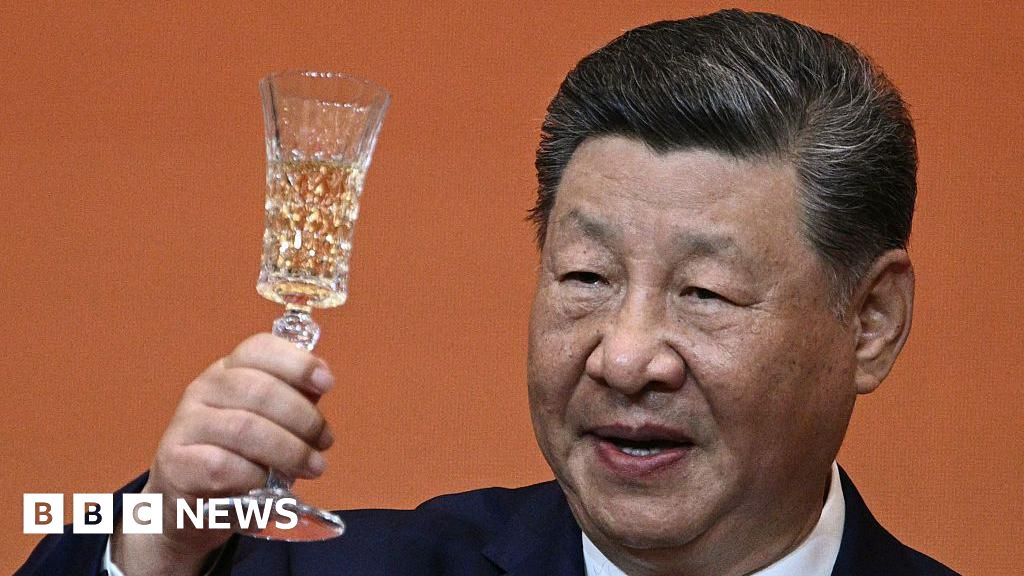
Xi Jinping hosted Vladimir Putin days after Donald Trump, highlighting China’s growing diplomatic leverage and its effort to position Beijing as a global center of power. The article says China and Russia signed 20-plus trade and tech agreements, but no approval was given for the long-stalled Russian gas pipeline, and Xi avoided mentioning Ukraine while calling the Iran war of "utmost urgency." The piece underscores China’s improved ties with major partners and its continued balancing act between neutrality, sanctions pressure, and geopolitical credibility.
Xi’s diplomacy is less about immediate policy concessions and more about re-pricing China’s optionality: Beijing is becoming the venue where sanctioned or politically isolated counterparts are forced to bargain, which improves China’s bargaining power in trade, payments, and commodity procurement over the next 6-18 months. The subtle winner is China’s supply-chain ecosystem — not just SOEs, but adjacent mid-cap manufacturers and logistics firms that can arbitrage rerouted trade flows, especially if Europe and parts of Asia keep de-risking without fully decoupling.
The biggest market implication is not headline rhetoric but the growing asymmetry in China-Russia energy trade. Russia’s need for capital goods, shipping, insurance alternatives, and settlement rails should deepen renminbi usage and non-Western payment channels, while keeping discounted crude flows into Chinese refiners structurally intact. That is mildly bearish for global seaborne crude benchmarks over the next 3-12 months, but it also raises the probability of selective sanctions escalation on entities facilitating those flows, creating a dispersion trade rather than a broad commodity short.
The contrarian read is that Beijing’s newfound centrality may be overestimated. China’s silence on Ukraine and selective moral framing on other conflicts can boost leverage with autocrats, but it weakens credibility with Europe just as China needs export markets and foreign capital. If Brussels concludes China is not a neutral broker, the second-order effect is tighter export controls on advanced manufacturing and more scrutiny of Chinese outbound investment — a medium-term headwind to China’s tech capex cycle and a tailwind to non-China industrial substitutes.
Near term, the risk is a policy surprise from Washington or Europe rather than a military one: targeted sanctions on shipping, insurance, or semiconductor-adjacent tech could hit China-linked supply chains within days to weeks. Over a longer horizon, if China’s domestic slowdown deepens, Xi may be forced to trade away more diplomatic autonomy for growth support, which would cap the current “all roads lead to Beijing” narrative. That makes this a leverage story, but one with fragile credibility and increasing sanctions surface area.
AI-powered research, real-time alerts, and portfolio analytics for institutional investors.
Request DemoOverall Sentiment
neutral
Sentiment Score
0.00
