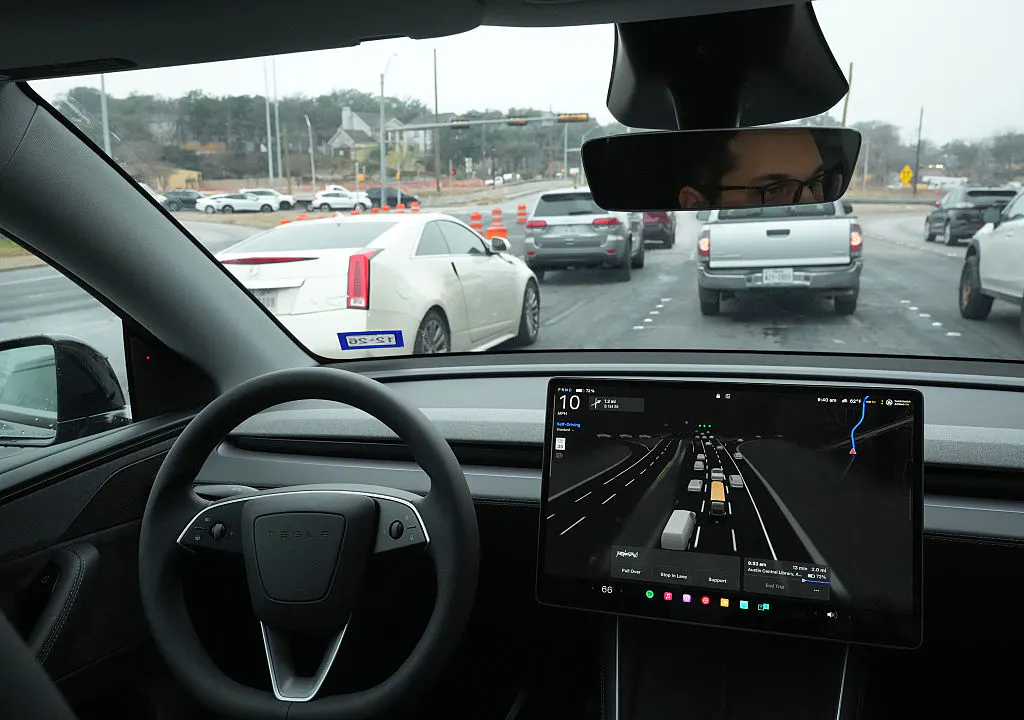
Tesla says Robotaxi has expanded to Dallas and Houston, but early data suggests only about one driverless vehicle is operating in each city, with coverage limited to roughly 30 square miles in Dallas and 25 square miles in Houston. The rollout underscores slow scaling versus prior promises, with Austin still at about 45 vehicles nearly a year after launch and most using a human safety monitor. Tesla reiterated a goal to reach nine markets by the first half of 2026, but that timeline now looks increasingly tight.
The key market issue is not the existence of a demo Robotaxi; it is the widening gap between narrative velocity and operational throughput. At this pace, autonomy is still a branding lever, not a near-term earnings bridge, which matters because the equity is already pricing a meaningful share of future software-like margin expansion. If the rollout remains constrained for the next 1-2 quarters, the stock’s incremental upside from autonomy headlines likely decays while the burden of proof shifts back to vehicle demand, pricing, and margin defense.
Second-order, the slow scaling supports incumbents with real fleet density today. A constrained Tesla network does not pressure Uber meaningfully in the near term; instead, it highlights that ride-hailing economics are still a utilization game, and the winner is whoever can deliver high availability across geographies. That makes TSLA’s autonomy push more of a competitive option value than an immediate threat to Uber’s core dispatch franchise, especially outside a few showcase zones.
The risk is asymmetric around expectations rather than technology. If Tesla misses its stated multi-market timeline into mid-year, the market will likely re-rate the autonomy story from ‘imminent monetization’ to ‘long-dated R&D,’ which could compress multiples even without any fundamental deterioration in auto sales. Conversely, a visible step-up in fleet count or a real-time booking experience that proves availability could re-ignite the bull case quickly, but the catalyst window is now measured in months, not days.
Contrarian read: the underappreciated signal is that Tesla is still treating rollout discipline as optional, which may be rational for optics but inefficient for commercialization. That creates a setup where headline expansion can be bullish on announcement day yet bearish on reflection if the market starts comparing promised market count versus actual cars on the road. In other words, the more Tesla leans on autonomy as a valuation support, the more fragile the stock becomes to slow execution.
AI-powered research, real-time alerts, and portfolio analytics for institutional investors.
Request DemoOverall Sentiment
mildly negative
Sentiment Score
-0.15
Ticker Sentiment
