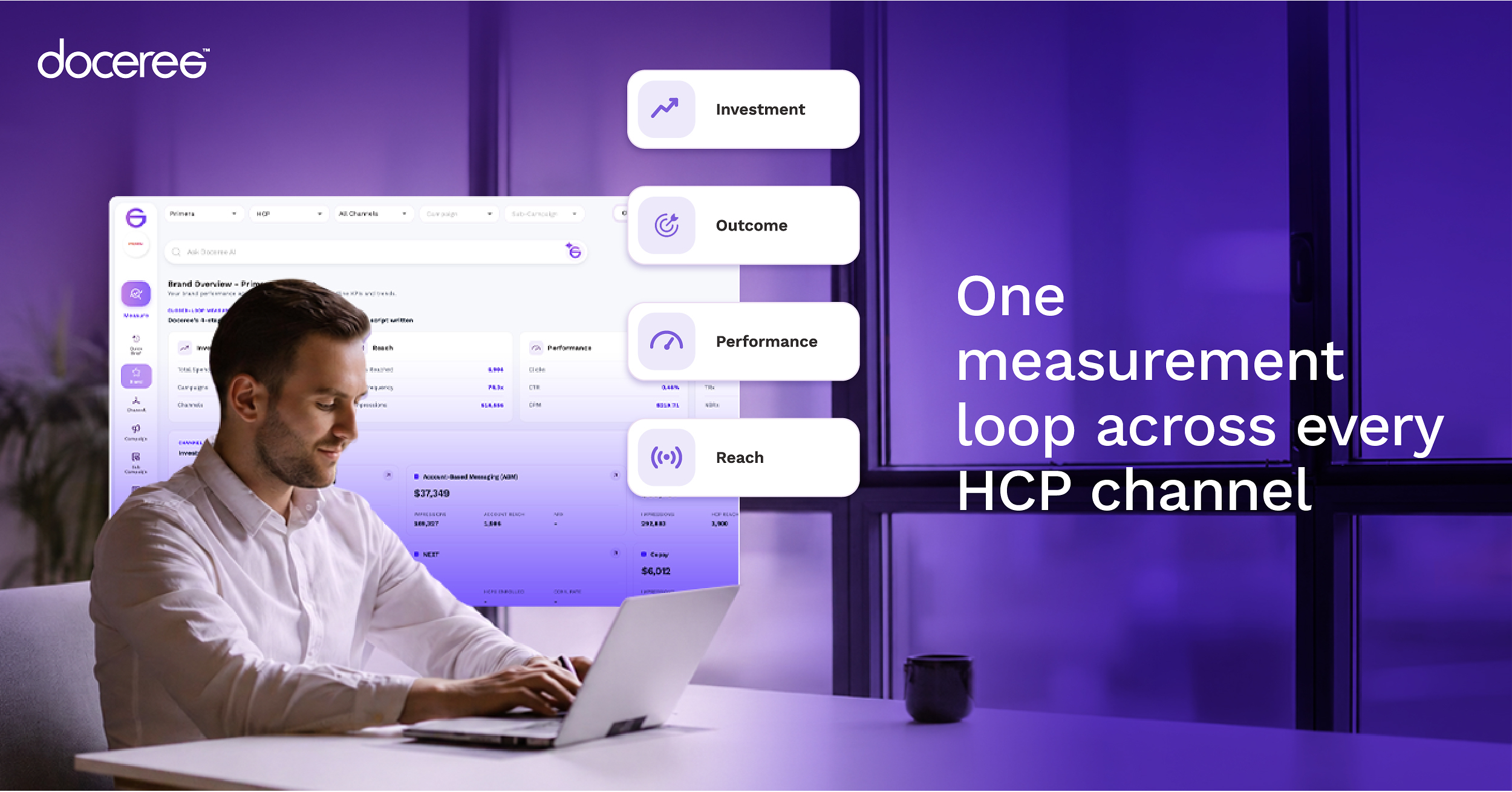
Doceree announced an expanded unified Closed Loop Measurement framework connecting healthcare marketing across 9 HCP channels (e.g., Point of Care, CTV, DOOH) on a single Investment→Reach→Performance→Outcome measurement language. The system leverages Clinical Intent Signals plus attention-based creative effectiveness (e.g., time in content, scroll depth) and adds physician-level data access for entitled clients, aiming to better link spend to downstream clinical and commercial outcomes as cookie-based attribution weakens. Rollout to existing clients is expected over the coming weeks.
This is less a product launch than a budget-control weapon. If buyers believe one vendor can reconcile point-of-care, CTV, email, and rep-facing channels on a common outcome metric, procurement shifts from buying media impressions to buying measurable lift, which tends to concentrate spend into fewer platforms and raise switching costs. The first-order beneficiary is any HCP-platform with dense publisher access and deterministic identity; the second-order winner is likely the measurement layer itself, because once finance teams can audit channel ROI in one dashboard, fragmented point solutions lose leverage.
The likely loser is the long tail of specialty adtech and analytics vendors whose value prop depends on partial attribution or delayed exports. Over 1-3 months, this should support multiple expansion for healthcare-advertising names that can credibly own workflow plus measurement, while compressing valuations for middleware that only reports activity. If the framework actually drives budget reallocation, the revenue effect will lag by a quarter or two, but gross margin should improve faster because better measurement usually reduces wasted impressions before it grows top line.
The contrarian read is that "outcome measurement" in pharma is often overstated until clients prove incrementality with controlled tests. The real falsifier is not product availability but client retention and spend expansion: if net revenue retention in the next 1-2 quarters does not inflect, the market should treat this as feature parity, not a moat. Also watch privacy/regulatory scrutiny around physician-level data; any tightening that delays PLD usage would blunt the upsell and push budgets back toward larger incumbents with broader compliance infrastructure.
AI-powered research, real-time alerts, and portfolio analytics for institutional investors.
Request DemoOverall Sentiment
mildly positive
Sentiment Score
0.35
Ticker Sentiment
