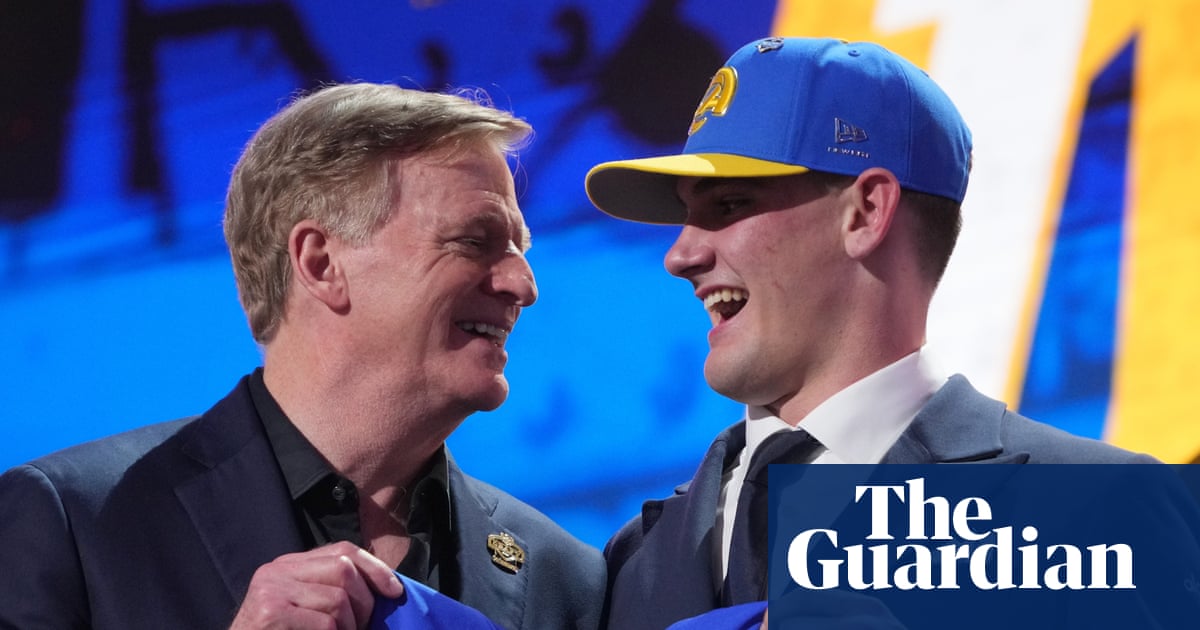
The article covers the NFL draft, highlighting the Raiders taking quarterback Mendoza first overall after his title-winning season at Indiana and the Rams shocking the draft by selecting Alabama QB Ty Simpson at No. 13. Simpson is expected to learn behind Matthew Stafford, while Mendoza heads to Las Vegas after completing 72% of passes for 3,535 yards, 41 touchdowns and 6 interceptions last season. The piece is largely descriptive and sports-focused, with no direct financial market implications.
The market-level takeaway is that quarterback scarcity is being priced as a multi-year portfolio problem rather than a one-year depth chart issue. Teams are now paying for optionality earlier in the draft because the cost of being wrong at QB dwarfs the opportunity cost of bypassing near-term value elsewhere; that should keep first-round QB valuations structurally elevated even when consensus grades say otherwise. The secondary effect is a wider dispersion between organizations with stable veteran bridges and those forced into accelerated rookie timelines.
For the Rams, the key signal is not the pick itself but the asymmetry it creates around Stafford-related planning. The organization is effectively buying a call option on succession while preserving current win-now equity, which reduces collapse risk if Stafford’s availability declines abruptly over the next 12-24 months. That kind of hedge tends to support shorter-dated competitiveness while compressing medium-term uncertainty, and it also increases the odds that the rookie develops in a high-value environment rather than getting ruined by immediate starters’ pressure.
The broader winner set is offenses with established infrastructure and pass-catching depth, because elite or quasi-elite QB insulation becomes the scarce resource. Conversely, teams that passed on premium skill talent to chase protection or defense may see slower marginal returns if their quarterback situation remains unresolved; the hidden cost is that defensive upgrades rarely close the gap if the offense lacks a high-end trigger man. The contrarian angle is that the league may be overestimating the immediacy of QB transition risk: veteran starters often keep the job longer than the market expects, so the “future now” narrative can suppress near-term upside for teams making these selections.
From a timing perspective, the most actionable window is the next 3-6 months, when camp narratives and preseason reps can re-rate teams’ offensive ceiling faster than box-score results. If the rookies look ready early, teams that passed on them will be forced into a reputational reset, but if they look developmental, the market will likely fade the hype and re-anchor valuations around incumbent starters, creating better entry points on the related offenses.
AI-powered research, real-time alerts, and portfolio analytics for institutional investors.
Request TrialOverall Sentiment
neutral
Sentiment Score
0.05
