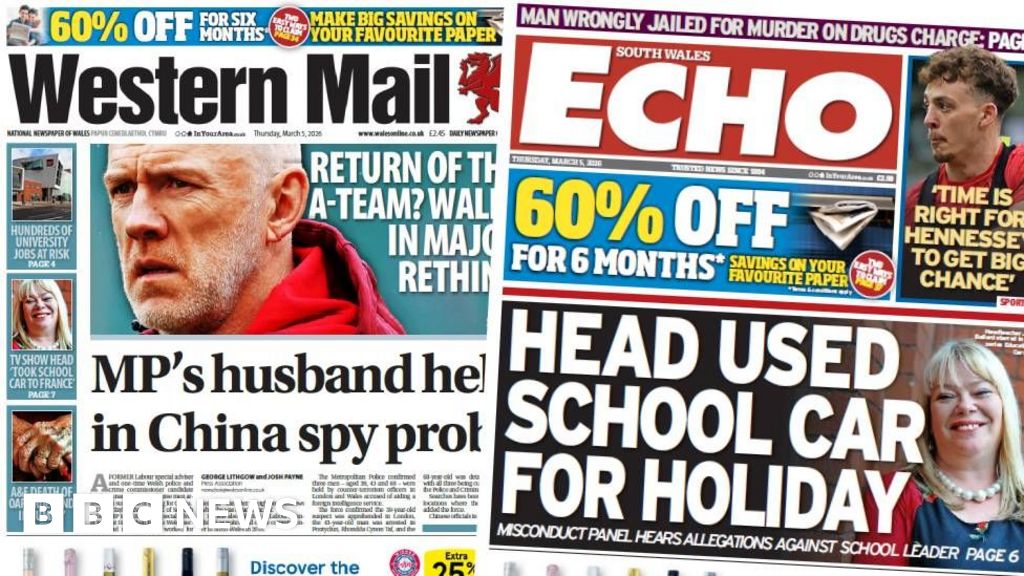
Regional Welsh papers report that an MP’s husband has been detained in a China-related espionage probe while a school head is alleged to have used a school car for a holiday. Both items are primarily reputational and legal/domestic-political stories with potential local political consequences but negligible direct financial impact on markets or corporate earnings.
Market structure: a local political/security scandal raises asymmetric upside for defence and cybersecurity vendors and modest downside for UK incumbents with China-facing exposure. Expect a 3–8% re-rating window for small/medium-cap defence names if UK parliamentary inquiries or government procurement reviews open within 30–90 days; pricing power for large primes (RTX, LMT, BA.L) improves if incremental contracts or export controls follow. FX/bond impact is likely small but real: gilts could cheapen by ~5–15bps and GBP weaken 0.5–2% on elevated political risk.
Risk assessment: tail risks include diplomatic escalation with China (low probability but high impact) that would disrupt supply chains (semiconductor, luxury retail) and prompt sanctions; that scenario could knock 10–25% off China-revenue exposed equities over 3–12 months. Hidden dependencies: UK universities, R&D partnerships, and supply-chain passthrough to European auto and semiconductor suppliers. Catalysts to watch in the next 30–90 days: formal parliamentary inquiry, election polling shifts >3–5 points, or official sanctions/visa restrictions.
Trade implications: prioritise tactical long exposure to defence and cyber while hedging UK political risk. Size trades for conviction: 1–3% portfolio exposure per theme with time horizons 3–9 months; use 3–6 month options to arbitrage volatility without long-term carry. Rotate 1–3% from China-exposed luxury/retail into defence/cyber; if polls/official actions occur, increase defence exposure to 3–5% and add short-GBP hedge.
Contrarian angles: consensus will treat this as a contained political story; the market underprices second-order supply-chain and regulatory spillovers into tech hardware and luxury retail. If the story escalates into formal state-level measures, defence and cyber names could re-rate quickly while some China-exposed stocks fall 10–20% — an opportunity to buy selectively on liquidity-driven dislocations. Conversely, if the probe fizzles within 30 days, short-term defensive longs may mean-revert; keep strike selection and sizing conservative.
AI-powered research, real-time alerts, and portfolio analytics for institutional investors.
Request TrialOverall Sentiment
neutral
Sentiment Score
0.00
