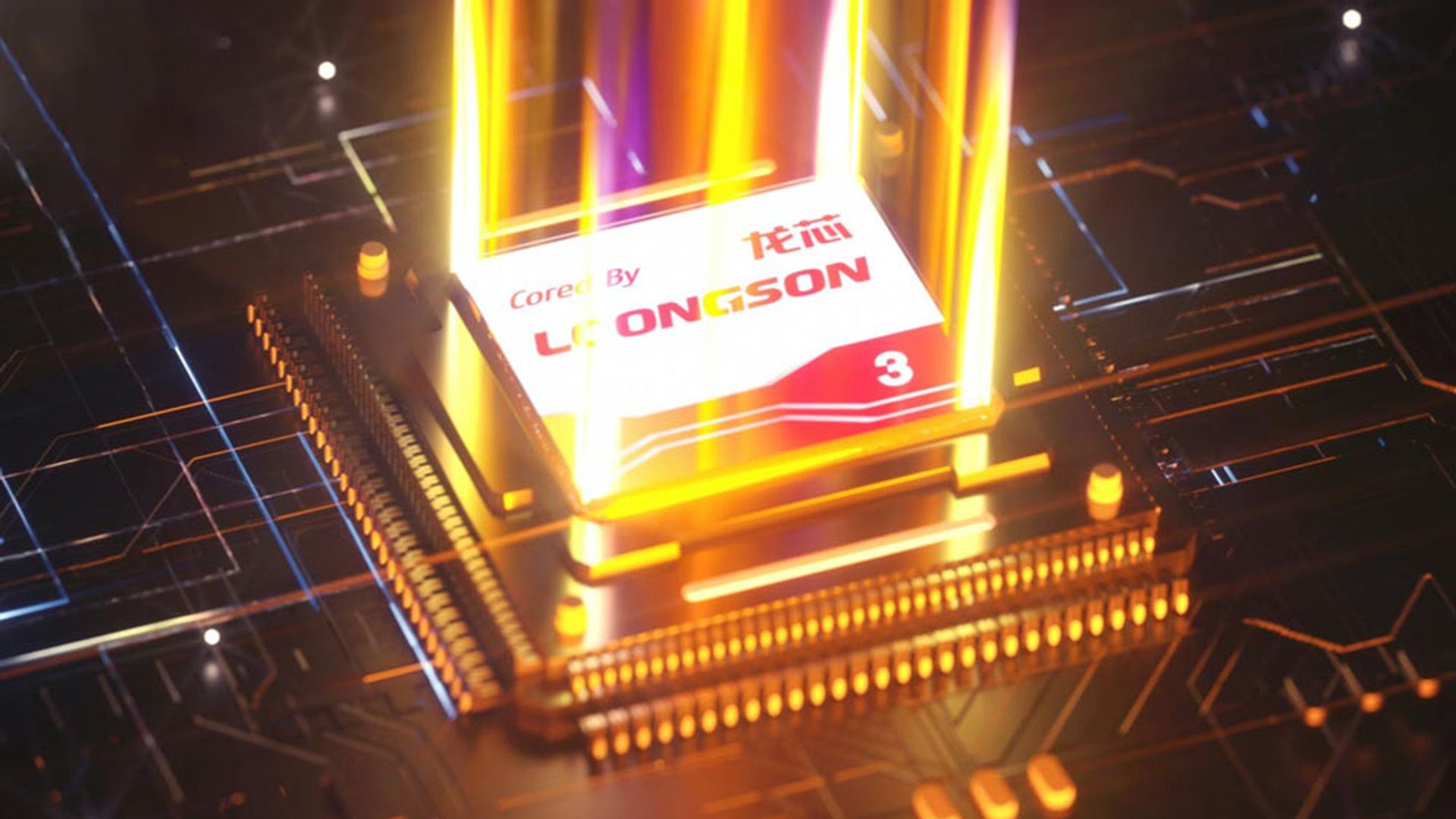
Benchmarking by Phoronix shows Loongson's 12-core 3B6000 (LA664) desktop CPU, clocked at ~2.5GHz, performs roughly three times slower than AMD's six-core Ryzen 5 9600X across most Linux workloads, though it matches or approaches high-end chips in a few niche tests (C-Ray 2.0, OpenSSL). The vendor's claimed IPC is comparable to Zen 3, but low clock speeds materially limit real-world performance; Loongson is developing an LA864 architecture targeting ~3.0–3.5GHz to narrow the gap with Intel Raptor Lake-class CPUs. For investors, these results underscore a substantial competitiveness deficit for China-made consumer x86 alternatives today, implying limited near-term commercial threat to Intel/AMD dominance absent meaningful architecture and clock-speed improvements.
Market structure: This result confirms incumbents (AMD, INTC) retain near-term product and pricing advantages — expect Western CPU vendors to keep >80% share of high-performance PC/server markets outside China for the next 12–24 months. Loongson’s 3B6000 shows core-count ≠ competitive performance when clocks and ecosystem are weak, so Chinese domestic OEMs will likely reserve Loongson for security-sensitive, low-to-mid performance segments, preserving ASPs for AMD/Intel in premium tiers.
Risk assessment: Main tail risks are geopolitical policy shifts — a Chinese mandate to substitute domestically could re-route 1–5% of AMD/Intel revenue within 1–2 years, and a successful LA864 launch (3–3.5GHz) could halve that timeline. Hidden dependencies include software/compiler optimization and board/memory configs (bench variability), meaning one-off benchmarks aren’t reliable predictors; watch official LA864 silicon/bench releases over 3–18 months as catalysts.
Trade implications: Short-term (days–months) this favors selective long exposure to AMD (AMD) and modest INTC exposure while avoiding China-specific hardware plays; longer-term (6–24 months) consider small thematic longs in semiconductor equipment (ASML/LRCX) if China scales fabrication investment despite export controls. Use options to skew risk: favor defined-risk bullish structures to capture upside without one-way exposure to geopolitical risk.
Contrarian angle: Consensus overweights the narrative of an inevitable Chinese CPU catch-up; the missing point is systems/ecosystem inertia (OS, compilers, OEM qualification) which takes years and favors incumbents. If LA864 fails to deliver demonstrable parity within 12 months, re-rate China’s domestic CPU TAM to sub-10% of global high-performance demand for the next 3 years.
AI-powered research, real-time alerts, and portfolio analytics for institutional investors.
Request DemoOverall Sentiment
moderately negative
Sentiment Score
-0.55
Ticker Sentiment
