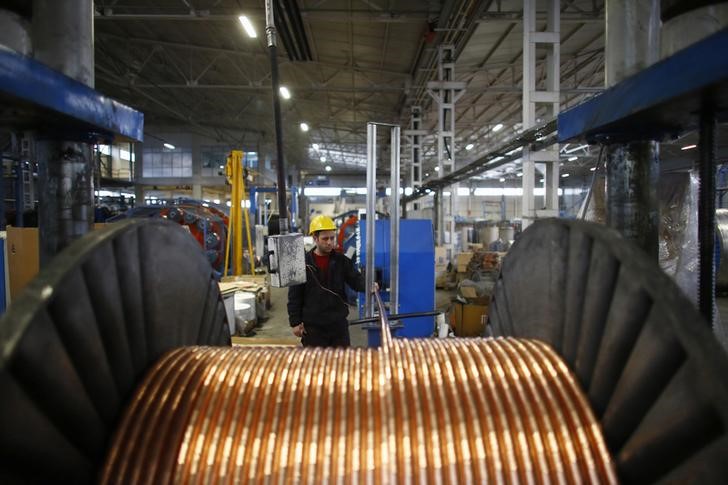
London copper was unchanged at $12,996 per metric ton after earlier falling to a three-week low, reflecting a stronger dollar, global growth concerns, and thin trading due to the Shanghai Futures Exchange holiday. Separately, renewed U.S.-Iran attacks in the Gulf and competition for control of the Strait of Hormuz raise risks to container shipping and broader trade flows. The geopolitical escalation is likely to keep risk sentiment fragile across commodities and transport markets.
The immediate market issue is not the headline risk itself but the probability distribution shift in freight and industrial input costs. A credible Strait-of-Hormuz disruption would hit tanker availability, insurance premia, and bunker costs before it shows up in commodity spot prices, creating a lagged squeeze on import-dependent manufacturers and shippers. Copper’s softness alongside the stronger dollar suggests cyclicals are already pricing slower global activity, so a Gulf shock risks an ugly combination: higher delivered costs and weaker end-demand.
The second-order winner is energy logistics, not necessarily outright crude producers. Narrow waterway chokepoints tend to reward vessel owners with exposure to longer rerouting miles and urgency demand, while penalizing fixed-contract shippers and ocean carriers with limited pass-through. In metals, copper can become a relative winner if the move is driven by logistics rather than demand: physical inventories outside the region may tighten, but Asian and European fabricators with thin working capital are more likely to de-stock first, creating a sharp but temporary down-leg in industrial metals before any supply squeeze emerges.
The key contrarian point is that the market may be overestimating duration and underestimating policy response. Gulf tensions usually create fast risk premium spikes that fade within days if escort regimes, ceasefire signals, or backchannel diplomacy appear; the real trade is the convexity around that headline cycle, not a linear thesis on higher oil. If the dollar keeps strengthening and China reopens from holiday with weak demand, the macro headwind could overwhelm the geopolitical bid, making the best expression a relative-value trade rather than a naked commodity long.
AI-powered research, real-time alerts, and portfolio analytics for institutional investors.
Request DemoOverall Sentiment
mildly negative
Sentiment Score
-0.15
