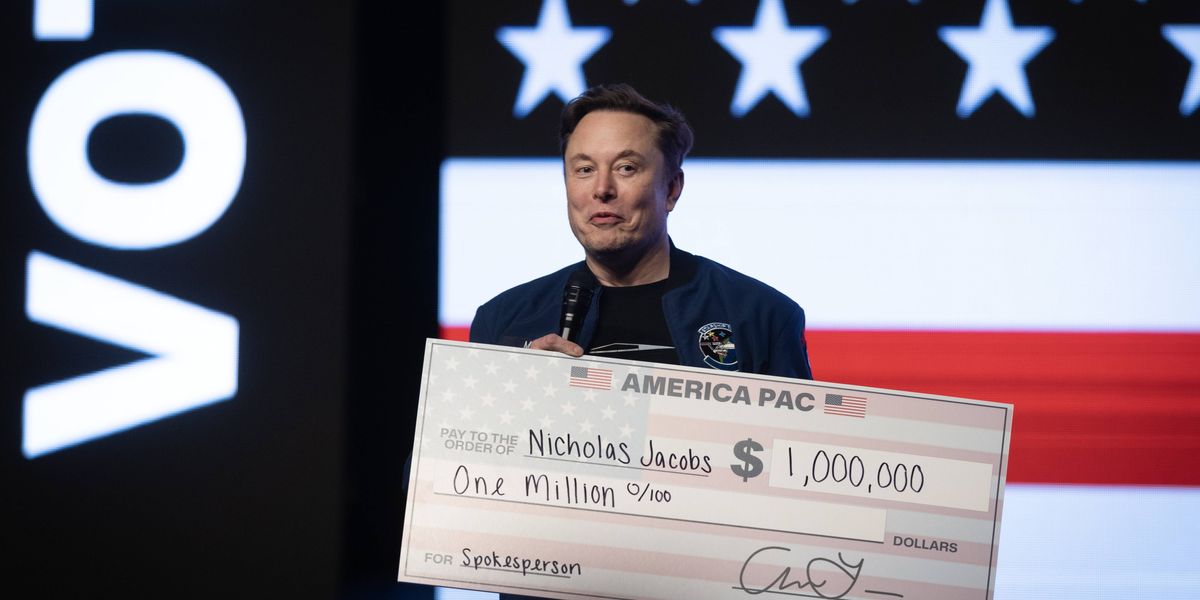
Billionaires and immediate family members (≈300) contributed about $3.0B—~19% of the ≈$16B spent in the 2024 US federal cycle—concentrating outsized influence in key races (e.g., ≈$47M from billionaires in Tim Sheehy’s Montana race; Stephen Schwarzman gave $8M to a super PAC and previously invested $150M in the candidate’s business). Major beneficiaries included Trump (Americans for Tax Fairness estimated $450M from 150 billionaire families pre-election; OpenSecrets reports >$250M from Elon Musk and >$100M each from Miriam Adelson and Timothy Mellon), and donors skewed roughly 5:1 toward Republicans vs. Democrats. Implications for portfolios: elevated political and regulatory risk for sectors targeted by donors (AI, crypto, pro‑Israel lobbying, tax policy and state-level battles such as California’s proposed 5% billionaire tax), alongside a higher probability of future reform efforts that could alter campaign‑finance, contracting and governance rules.
The core market implication is an unusually high concentration of political leverage inside a small set of ultra‑wealthy owners — that changes the mapping between corporate strategies and public policy. Firms whose CEOs/founders are active political funders will carry idiosyncratic political beta on top of their operating beta; that amplifies event-driven volatility around campaign cycles, appointments, and state ballot fights and makes traditional valuation multiples less stable.
Second‑order winners are businesses selling regulatory arbitrage or privatization solutions (private asset managers, AI vendors to government, for‑profit education/charter operators) because concentrated capital can accelerate policy change in their favor; losers are incumbents exposed to populist regulatory backlash (platforms with visible founder influence, large public contractors reliant on favourable procurement rules). The mechanism is directional: short, sharp policy wins from heavyweight donors increase the probability of a subsequent reform wave aimed at curbing those same channels — a multi‑year mean reversion risk to current “policy capture.”
Watchable catalysts over distinct horizons: within months — state ballot outcomes, PAC cash flow disclosures, and high‑profile confirmation hearings; 6–24 months — targeted statutes, procurement rules, or disclosure requirements; 2–5 years — structural reforms (campaign finance, contractor bans) that materially reprice political exposure. For portfolio construction, treat political‑capital exposure as a tradable risk factor and size positions accordingly, preferring option structures to linear equity where political tail risk is large and binary.
AI-powered research, real-time alerts, and portfolio analytics for institutional investors.
Request DemoOverall Sentiment
strongly negative
Sentiment Score
-0.65
Ticker Sentiment
