
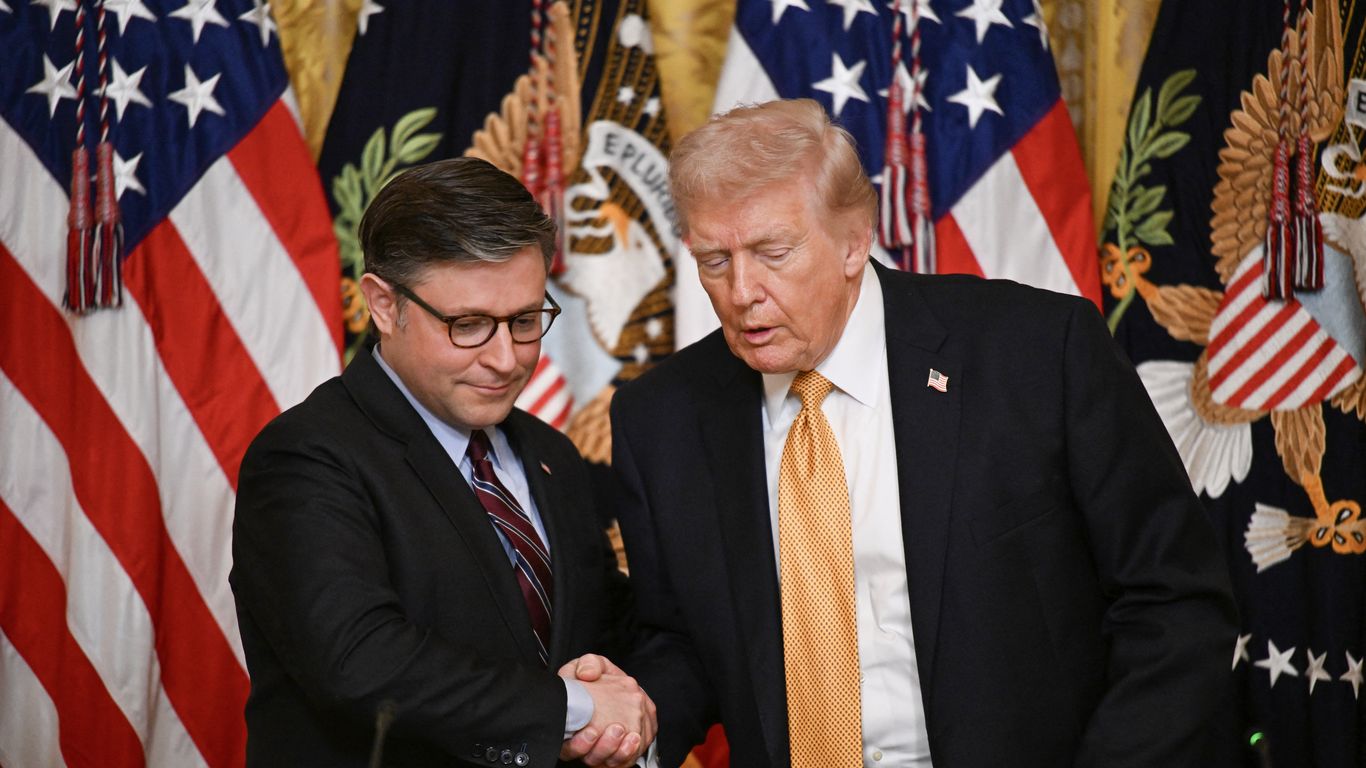
House Republicans failed to pass a clean extension of Section 702 FISA powers, forcing a 10-day stopgap extension after more than two dozen GOP members voted down two procedural votes. The setback exposed limits in President Trump's influence over his party and left Speaker Mike Johnson with a fractured conference and a tight 12-day window to reach a broader deal. The episode is politically negative but likely has limited direct market impact beyond defense, intelligence, and governance-related policy uncertainty.
The market implication is less about FISA itself and more about the signal it sends on governing capacity: a majority that cannot reliably clear procedural votes has a rising probability of short-duration funding and policy disruptions. That typically compresses the value of “known outcome” Washington trades and widens the dispersion between regulated-businesses that need legislative clarity and those insulated by federal noise. The immediate beneficiary is the small set of contractors and security-adjacent firms that can monetize uncertainty through delay-sensitive appropriations and renewals, while the larger loser set is any cohort whose valuation depends on stable rulemaking cadence.
The second-order effect is on the credibility of the White House whip operation. If a President who usually closes the deal cannot move his own lane on a high-salience national-security vote, the same weak signal can spill into debt-ceiling, appropriations, and year-end tax negotiations over the next 1-3 months. That raises tail risk for short-duration volatility in rates and defense procurement headlines, but also creates a tactical window where markets may underprice the probability of another stopgap extension after the next hard deadline. In other words, the more the process looks broken, the more the market should discount near-term legislative “finality.”
The contrarian view is that this may be more about process theater than policy drift: a 10-day patch preserves the status quo and reduces the odds of any immediate operational interruption. If a deal materializes within two weeks, the selloff in governance-sensitive names should fade quickly because the underlying program is not being repealed, just delayed. The bigger risk is not a single failed vote, but repeated evidence that leadership cannot enforce discipline; that would warrant a higher volatility regime premium across defense, telecom, and regulated infrastructure proxies.
For the named national-security constituency, the economic impact on CIA is effectively zero today, but the read-through is to the broader ecosystem of intelligence contractors and defense primes that benefit from elevated perceived threat and program continuity. The tradeable edge is in optionality around legislative deadlines, not directional conviction on the policy outcome itself.
AI-powered research, real-time alerts, and portfolio analytics for institutional investors.
Request TrialOverall Sentiment
mildly negative
Sentiment Score
-0.20
Ticker Sentiment
