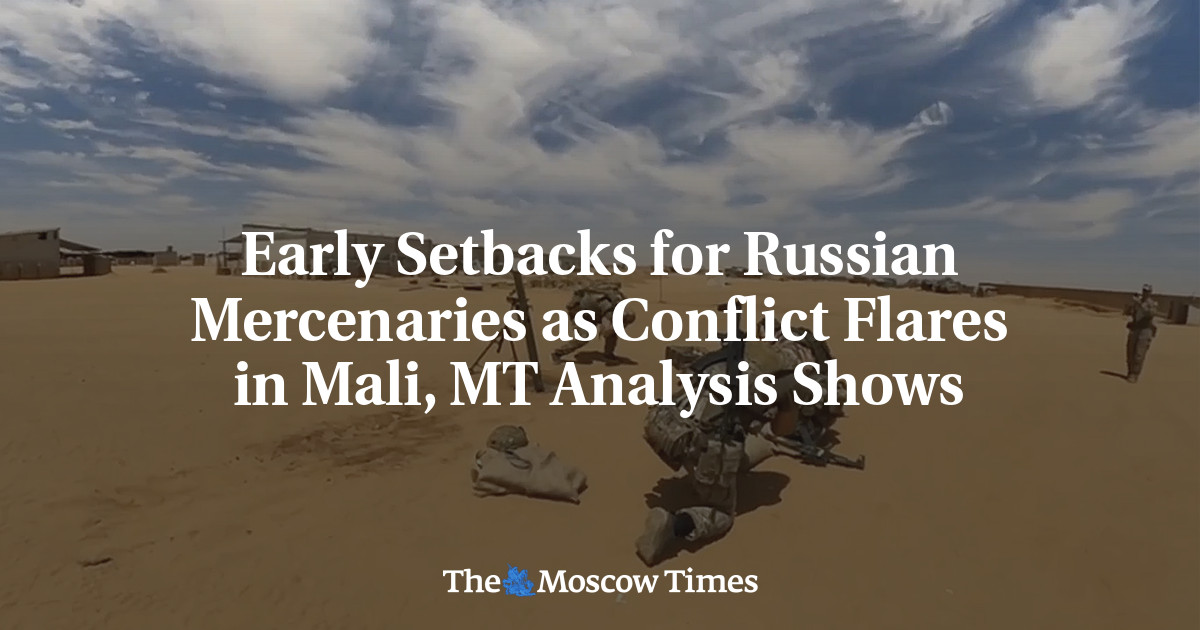
Mali’s central government and Russian-aligned Africa Corps suffered major setbacks after weekend attacks left the defense minister dead, Kidal reportedly captured, and the president in hiding. The Africa Corps announced a withdrawal from Kidal, with videos and satellite imagery indicating destroyed or evacuated military equipment and possible fighting near a key northern base. The report points to a significant deterioration in security conditions and a setback for Russia’s military position in Mali.
This is less a Mali-specific headline than a stress test of Russia’s expeditionary model. The first-order loss is tactical, but the second-order damage is credibility: a retreat under pressure makes future local partners discount Russian security guarantees, raising the “cost of enforcement” across the Sahel. That matters because Russia’s African footprint is built on a small number of high-visibility deployments; once one theater looks brittle, recruiting, host-nation bargaining power, and contract renewal economics all deteriorate at the margin.
The more tradable implication is not an immediate commodity shock but a rising probability of security-fragility spillovers into infrastructure and logistics. A weakened northern perimeter increases the odds of intermittent attacks on roads, airports, and mineral-adjacent corridors over the next 1-6 months, which can delay project timelines, insurance pricing, and working-capital cycles for EM operators with Sahel exposure. Expect the market to underprice this until there is a visible hit to evacuation costs, convoys, or base hardening budgets.
The key contrarian point is that the asset destruction may be less economically meaningful than the narrative suggests if the force can preserve its airfield/logistics hub and rotate personnel. In that case, the best trade is not a panic short on broad EM beta, but a relative-value expression against specific Russia-linked geopolitical beneficiaries whose premium depends on the myth of control. The setup favors a fast, headline-driven de-rating in proxy assets, but sustained impairment requires proof that resupply, mobility, and force protection are truly compromised for multiple weeks.
AI-powered research, real-time alerts, and portfolio analytics for institutional investors.
Request DemoOverall Sentiment
strongly negative
Sentiment Score
-0.82
