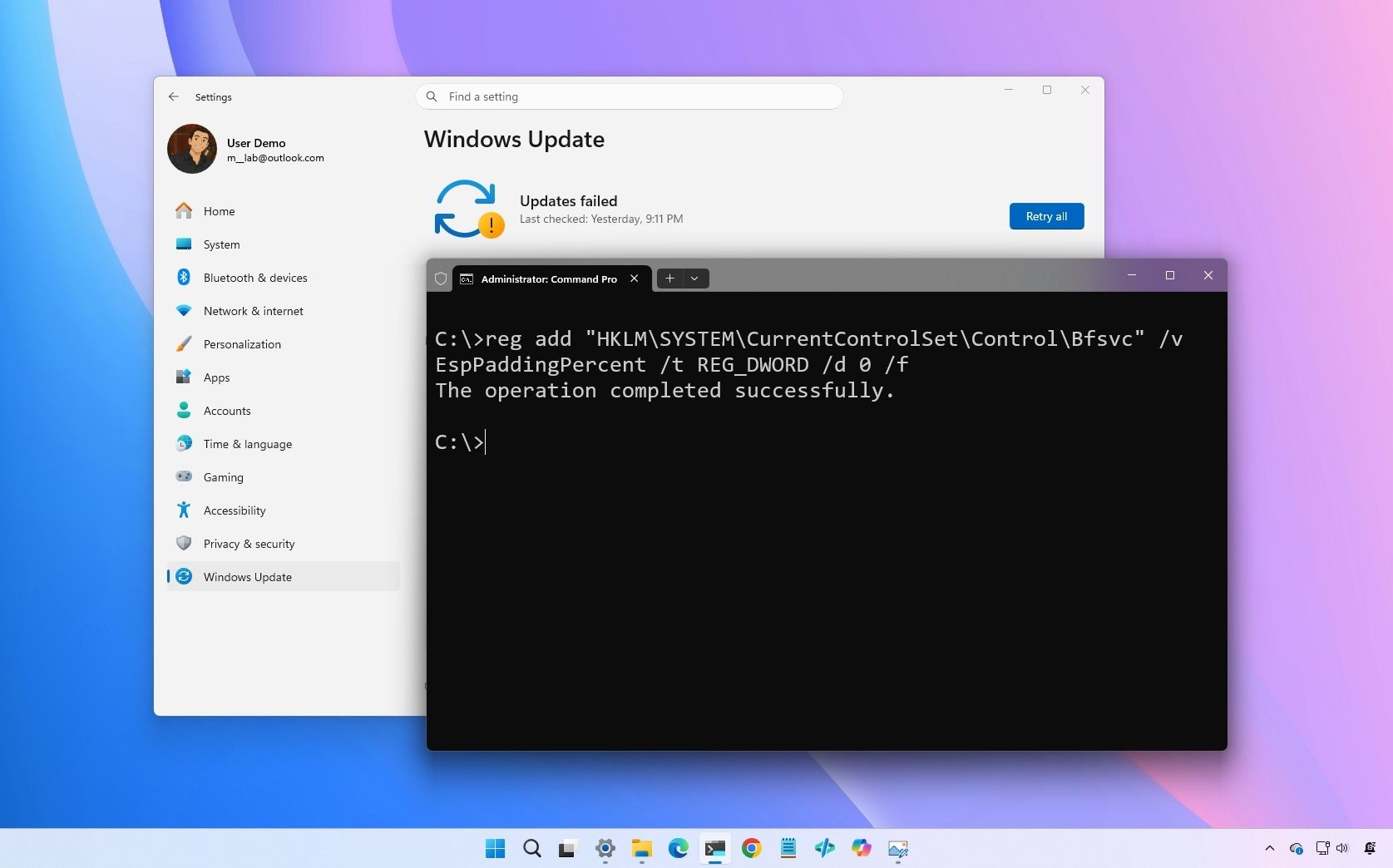
Microsoft confirmed that the Windows 11 May 2026 Security Update (KB5089549) is failing to install on some systems with error 0x800f0922, especially devices with 10MB or less free space in the EFI System Partition. The company has already pushed a Known Issue Rollback mitigation for consumer and unmanaged business PCs and provided a registry-based workaround for persistent failures, while a permanent fix is still in development. This is a contained software issue with limited market relevance, though it could affect user experience and update reliability on Windows 11 devices.
This is not a demand shock for Microsoft; it is a reliability tax on the Windows servicing stack that can leak into sentiment around enterprise manageability and upgrade cadence. The immediate market implication is a modest but real drag on PC ecosystem confidence: when update failures are tied to low-level partition hygiene, it highlights how much of Windows’ installed base still sits on aging, heterogeneous hardware where automation breaks down. That tends to favor vendors whose value proposition is endpoint control, observability, and fleet remediation rather than pure OS layer exposure.
Second-order, the issue is more likely to show up as IT labor churn than lost licenses. Enterprises that hit repeated install failures may delay rollouts by weeks, which can temporarily slow downstream monetization of adjacent software/services tied to newer Windows builds, but the bigger effect is incremental demand for admin tooling, patch management, and security orchestration. In that sense, a soft failure mode for Microsoft can be a relative tailwind for Cisco’s security/network management stack if customers prioritize segmentation and policy enforcement over broad OS upgrades.
The contrarian read is that this is probably too small to matter financially unless it becomes a recurring pattern across cumulative updates. Known Issue Rollback and the narrow device condition suggest the base case is a contained support event, not a material revenue or guidance risk. The real watch item is reputational: if update fragility becomes a narrative, CIOs may extend hardware refresh cycles and tighten approval gates, which would pressure PC replacement velocity and could modestly delay near-term Windows 11 migration benefits.
Catalyst-wise, the next 1-2 weeks matter for whether the workaround fully suppresses helpdesk noise; the next 1-2 quarters matter for whether enterprise customers treat this as isolated or systemic. If Microsoft lands a clean permanent fix quickly, the headline fades; if not, each subsequent servicing issue compounds the perception that newer Windows builds are more sensitive to legacy configurations and hidden storage constraints.
AI-powered research, real-time alerts, and portfolio analytics for institutional investors.
Request DemoOverall Sentiment
mildly negative
Sentiment Score
-0.15
Ticker Sentiment
