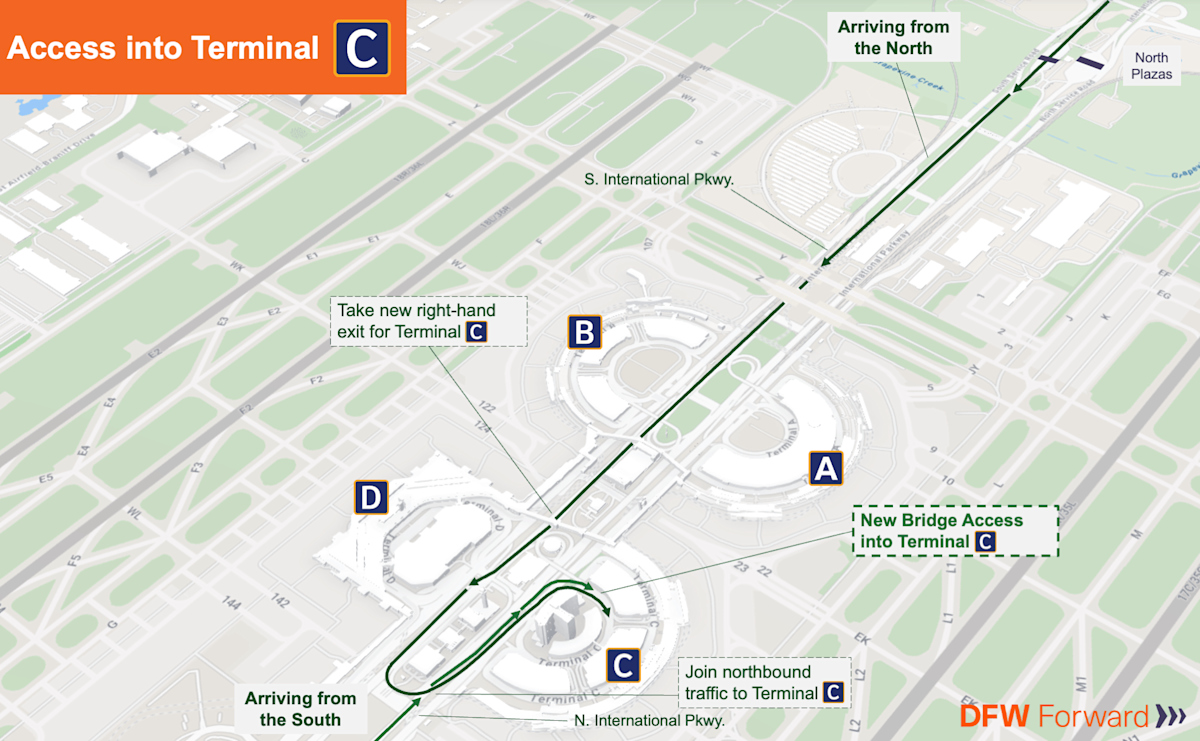
DFW expects about 1.6 million travelers from May 21-26, a 5.8% increase year over year, with peak congestion on Thursday, Friday and Monday around late morning and early evening. The airport outlined terminal access changes, transit options, parking tools and curbside rules to manage Memorial Day demand. The update is operational and informational, with minimal direct market impact.
This is less a demand shock than a yield-quality signal for the airline complex. AAL is the clearest direct beneficiary because DFW is a major hub and the operational changes reduce friction at a time when banks of departures can still create spillover delays; that supports on-time performance, protects completion factor, and can lift ancillary conversion at the margin. The bigger second-order effect is not unit revenue, but lower irregular-ops costs and fewer misconnects, which matter disproportionately into peak summer when a single clogged weekend can distort monthly controllable completion metrics.
The market may be underestimating the asymmetric benefit to airport-adjacent infrastructure and payment rails rather than airlines alone. Cashless exits, TollTag lanes, and prebooked parking improve throughput and increase monetization per vehicle without adding physical capacity, which is a quiet positive for airport economics and for regional mobility operators that can route around curbs. Conversely, rideshare and parking operators face temporary demand displacement if travelers precommit to transit or prebooked parking, but that is likely a timing shift, not a lost trip.
From a risk standpoint, the catalyst window is days, not months: peak congestion around the holiday can either validate the airport’s operational improvements or expose bottlenecks. The real tail risk is a weather disruption, staffing issue, or construction-related routing confusion that turns a manageable volume spike into visible delay media, which would pressure airline sentiment and DFW-linked throughput assumptions. Over a longer horizon, the infrastructure upgrades are mildly bullish for DFW’s ability to preserve hub share versus competing Texas gateways, but that is a gradual, multi-quarter effect rather than a tradable holiday-weekend theme.
Consensus may be missing that higher traffic is not automatically bullish for airlines if it comes with more ground congestion and longer turn times; the first-order headline is volume, but the tradable edge lies in how much of that volume can be processed without delay propagation. If DFW executes cleanly, the summer travel season narrative improves for AAL with limited incremental cost. If it does not, the market will likely punish the hub carrier more than the airport operator, because investors usually price the revenue upside faster than the operational downside.
AI-powered research, real-time alerts, and portfolio analytics for institutional investors.
Request DemoOverall Sentiment
neutral
Sentiment Score
0.05
Ticker Sentiment
