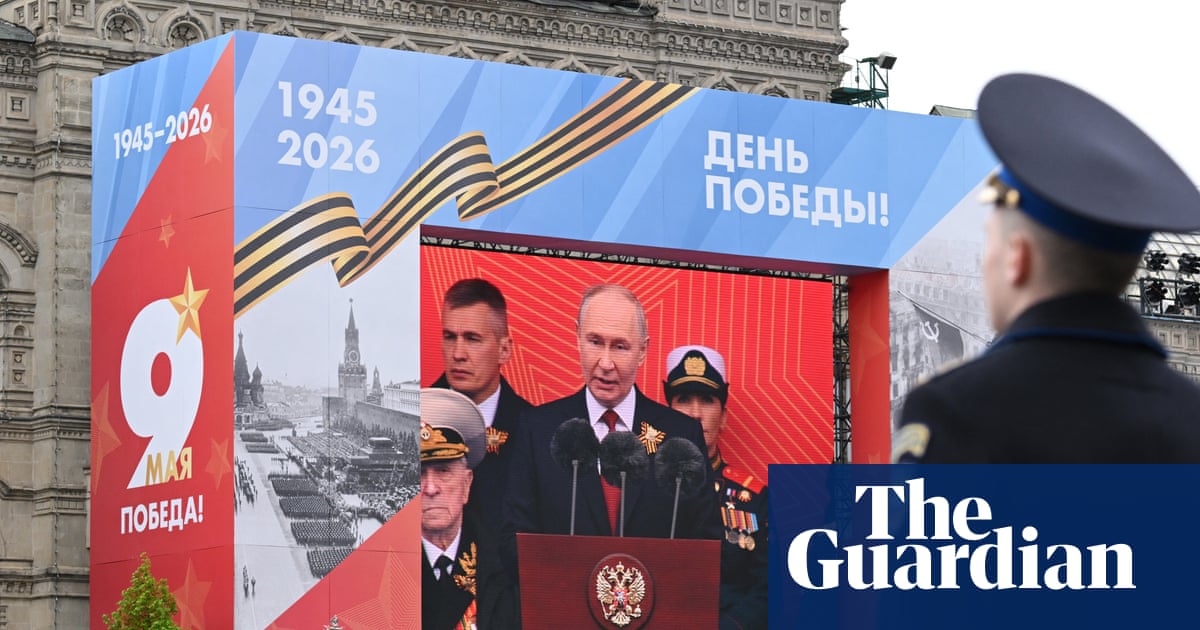
Russia held a scaled-back Victory Day parade under heavy security, with internet blackouts, no missile or armored vehicle display, and clear signs of strain from the war in Ukraine. The article highlights mounting public fatigue, slowing economic growth, rising inflation, record budget deficits, and stalled battlefield progress, while ceasefire talks remain blocked by Moscow's demand that Ukraine withdraw from Donetsk. The geopolitical risk backdrop remains elevated, with potential implications for defense, energy, and broader European risk sentiment.
The key market signal is not the parade optics; it is the widening gap between Kremlin rhetoric and state capacity. That gap tends to create two tradable effects: first, a persistent war-premium in European defense and cyber/security names as Moscow leans harder on asymmetric tools; second, incremental pressure on Russian fiscal flexibility as security costs, mobilization spending, and subsidy needs rise while growth slows. The second-order risk is that a more constrained Kremlin becomes more dependent on coercive escalation rather than compromise, which keeps tail risk elevated even if headline combat intensity looks static.
For Europe, the most actionable implication is a higher probability of intermittent infrastructure disruption rather than a clean kinetic escalation. That favors hardening beneficiaries: grid equipment, satellite communications, secure networking, and defense electronics. The supply-chain angle matters too: drone warfare increases demand for optics, jammers, batteries, semiconductors, and compact propulsion systems, so the trade should not be limited to large primes.
On the Russian side, the macro mix is deteriorating in a way that is typically late-cycle for war economies: inflation with slowing output and widening deficits. That combination is usually bearish for the ruble over a multi-month horizon unless energy prices or capital controls offset it; it also raises the odds of more domestic repression, internet controls, and administrative distortions. The consensus may be underestimating how much this bleeds into consumer confidence and non-defense private investment, which can create lagged weakness well beyond the battlefield.
Contrarianly, the absence of a visible breakthrough does not mean de-escalation is near. Stalemate can be bullish for defense spend because it prolongs procurement cycles and accelerates stockpile replacement, but it can also cap the market's willingness to bid up European cyclicals if investors view the region as structurally hostage to intermittent security shocks. The best risk/reward is therefore in selective beneficiaries of prolonged defense spending and resilience capex, not broad geopolitical beta.
AI-powered research, real-time alerts, and portfolio analytics for institutional investors.
Request DemoOverall Sentiment
moderately negative
Sentiment Score
-0.35
