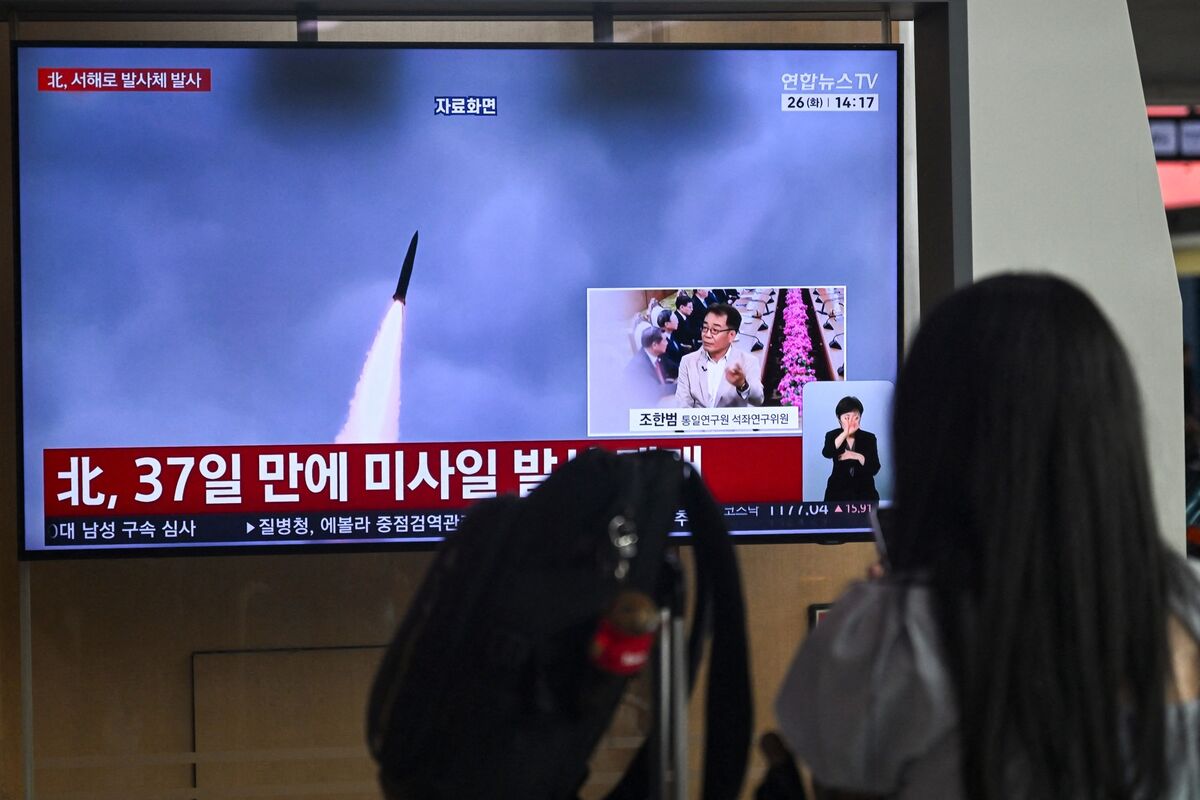
North Korea fired multiple projectiles, including short-range ballistic missiles, into waters off its west coast on Tuesday, according to South Korea’s military. The test extends Pyongyang’s run of weapons launches this year and reinforces regional security tensions. The news is geopolitically negative but likely to have limited direct market impact unless it triggers broader escalation.
This is a low-direct-impact geopolitical flare-up, but the second-order effect is a modest lift to regional risk premia rather than a clean defense bid. The market usually prices these events first through FX and rates: KRW and JPY tend to catch the initial safety impulse, while Korean equities and cyclicals see a larger knee-jerk than global defense names unless the episode escalates into a broader military or sanctions response. In other words, the immediate trade is more about volatility and hedging than picking a single “winners” basket.
The key question is whether this test changes procurement or posture. On its own, it is unlikely to move long-cycle defense budgets, but it can accelerate short-cycle spending on missile defense, radar, command-and-control, and hardened infrastructure in South Korea, Japan, and potentially the US Indo-Pacific footprint. That creates a subtle advantage for suppliers with near-term replenishment exposure and less for primes whose order books already reflect elevated strategic tension.
The contrarian angle is that these headlines are often overread by defense bulls and underread by risk desks: absent a follow-on provocation, the signal usually decays within days and does not justify chasing broad defense multiples. The more durable opportunity is in optionality around a tail event, not in outright beta. If the episode stays contained, any risk-off move in Korea-sensitive assets should mean-revert quickly; if it escalates, the beneficiaries are asymmetrically those tied to missile defense capacity and regional hedging flows.
Catalysts to watch over the next 1-4 weeks are retaliation rhetoric from Seoul/Tokyo/Washington, additional tests, and any shift in joint exercises or sanctions talk. A credible escalation path would raise demand for defense systems and support USD, while de-escalation or diplomatic signaling would unwind the premium fast. Given the modest impact score, this is a volatility setup rather than a conviction macro regime change.
AI-powered research, real-time alerts, and portfolio analytics for institutional investors.
Request DemoOverall Sentiment
mildly negative
Sentiment Score
-0.20
