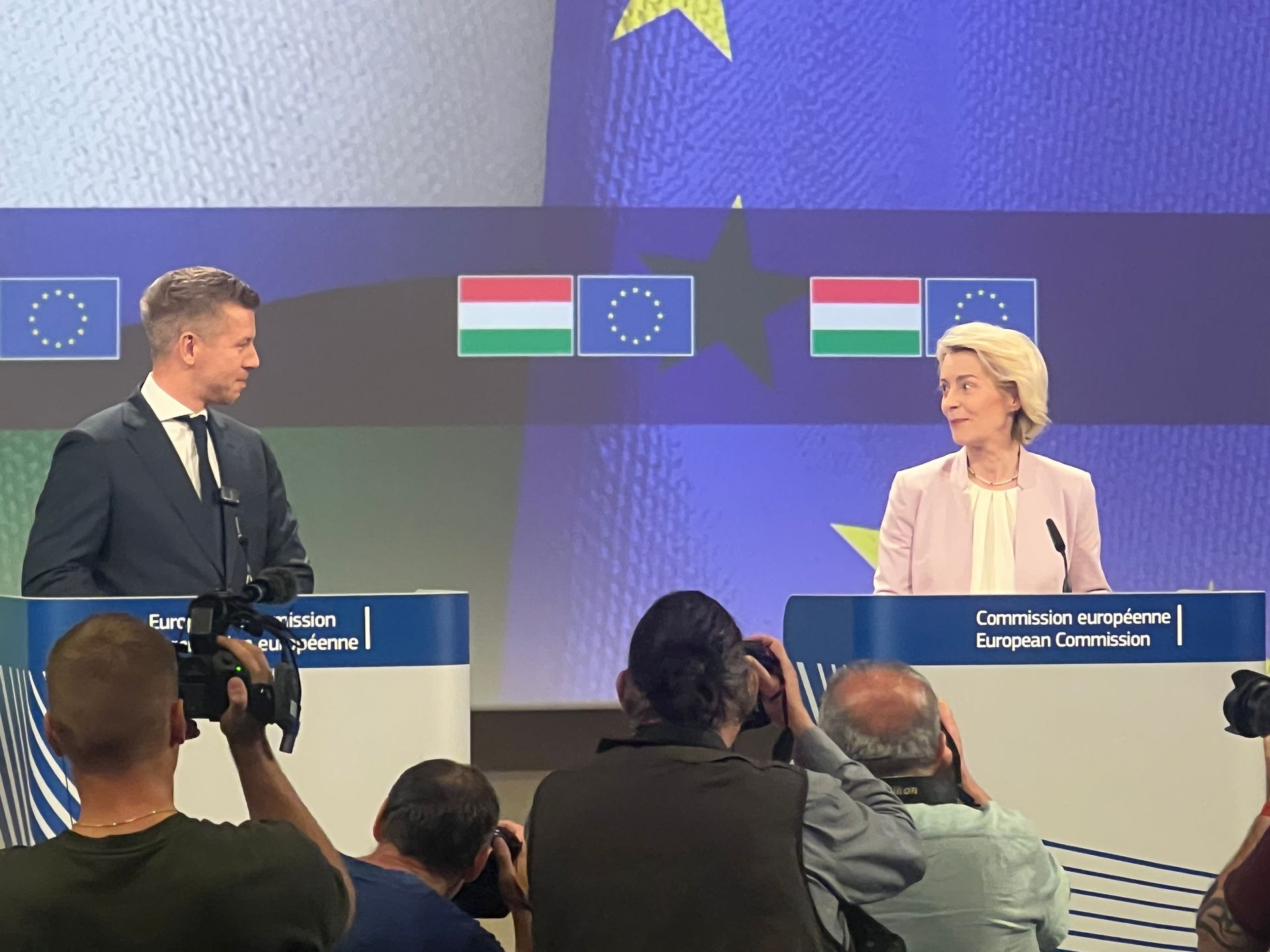
Hungary is set to receive 16.4 billion euros ($19 billion) in previously frozen EU funds after Ursula von der Leyen said 10 billion euros would be unblocked immediately, with a further 6.4 billion euros to follow. The announcement reduces a major fiscal overhang for Hungary, even as EU-Ukraine accession talks remain tied to Hungary's veto over minority rights and agricultural import issues. The article signals progress on EU funding and diplomacy, but the direct market impact is likely limited outside Hungarian sovereign and regional assets.
The immediate market read is not the headline transfer itself, but the signaling value: Brussels is showing it can use funding leverage to keep a fractious member state inside the tent while still preserving a hard line on enlargement optics. That lowers near-term tail risk for Hungarian sovereign and local assets, but it does not solve the more material issue for risk markets: Hungary remains the veto point on Ukraine accession, so a single domestic political actor can still reprice the path of EU institutional credibility within days.
For Kyiv-linked assets, the most important second-order effect is that the accession process is becoming a sequence of binary political checkpoints rather than a linear reform story. That creates event-driven volatility over the next 2-6 weeks around the June decision window, with upside if Hungary blinks and downside if talks on minority rights stall; the market should expect sharp moves in EU-proxy EM assets rather than a slow grind. The longer-term risk is that repeated last-minute bargaining normalizes accession as a hostage mechanism, compressing the probability that EU funds translate into faster capital inflows into Ukraine.
The contrarian angle is that this is mildly bullish for Ukraine only if investors stop treating EU support as a straight-line catalyst. In practice, the unlock to Hungary may actually increase Budapest’s bargaining power by proving the EU will pay for compliance, which means future concessions on Ukraine could become more expensive and slower. That argues for fading any knee-jerk optimism after positive headlines, because the constraint is political optionality, not financing capacity.
From a portfolio standpoint, the cleanest expression is to buy the assets least sensitive to the headline and short the ones most exposed to delayed accession. The best risk/reward is a tactical long in Hungarian local duration or EUR/HUF on the view that frozen-funds uncertainty is a tailwind for the forint, paired against a short basket of Ukraine beta that rallies on accession optimism. For event risk, options are preferable because the next catalyst is date-specific and the path dependency is high.
AI-powered research, real-time alerts, and portfolio analytics for institutional investors.
Request DemoOverall Sentiment
mildly positive
Sentiment Score
0.15
Ticker Sentiment
