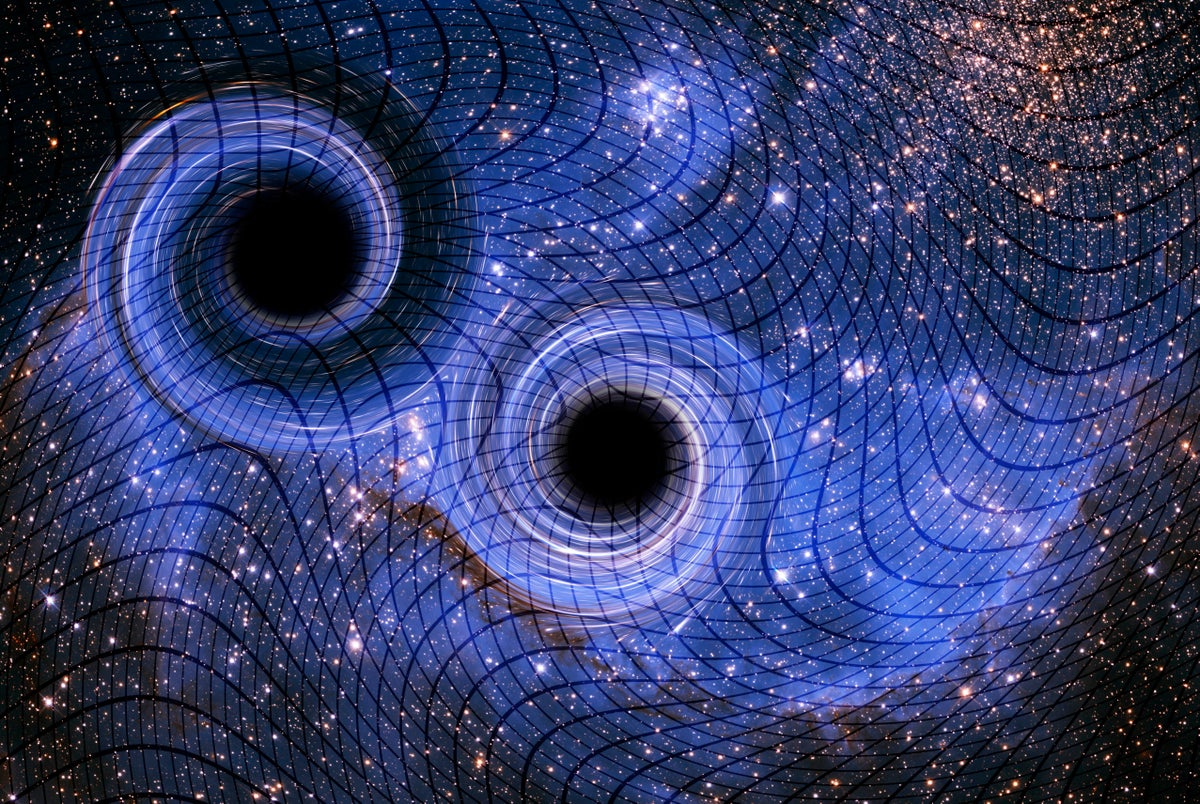
The LIGO-Virgo-KAGRA collaboration added a record 161 gravitational-wave events between April 2024 and January 2025, bringing the confirmed total to 390. Researchers highlighted improved detector sensitivity, a clearer-than-ever signal in GW250114 with a 76.9 signal-to-noise ratio, and evidence supporting second-generation black holes. The update is scientifically important and signals continued progress in precision gravitational astronomy, but it is unlikely to have direct market impact.
The key economic implication is not the discovery itself but the step-change in data cadence: once an observational field moves from sparse detections to weekly frequency, the bottleneck shifts from instrument validation to computational throughput, storage, and model interpretation. That tends to benefit the less visible picks-and-shovels layer: high-performance compute vendors, data-center interconnect, precision timing, and simulation software, because the marginal value of each added event is highest when pipelines are automated and low-latency. The market is likely underestimating how quickly recurring scientific missions create procurement budgets with multi-year visibility, even when the end-customer is a public consortium rather than a commercial buyer.
The second-order winner is adjacent industrial infrastructure, not pure-play “space/physics” names. Detector upgrades and sensitivity improvements are capital-intensive and usually diffuse across optics, cryogenics, vacuum systems, sensors, and specialty materials, which favors diversified component suppliers over headline-grabbing scientific equipment manufacturers. The useful framing is that every incremental gain in sensitivity expands the addressable observation volume nonlinearly, so future value creation will compound even if event counts only rise modestly; that argues for a longer-duration infrastructure lens rather than a short-lived news trade.
The contrarian risk is that excitement can outrun monetization. For public-market exposure, this is mostly a sentiment tailwind unless and until the workflow translates into sustained government funding or commercial spinoffs; otherwise, the opportunity remains academic and procurement-driven, with long lags and lumpy spending. In the nearer term, the main reversal catalyst would be budget compression in Europe/Japan or a temporary plateau in detector performance, which could deflate expectations over 6-18 months even as the science story stays intact.
AI-powered research, real-time alerts, and portfolio analytics for institutional investors.
Request DemoOverall Sentiment
mildly positive
Sentiment Score
0.35
