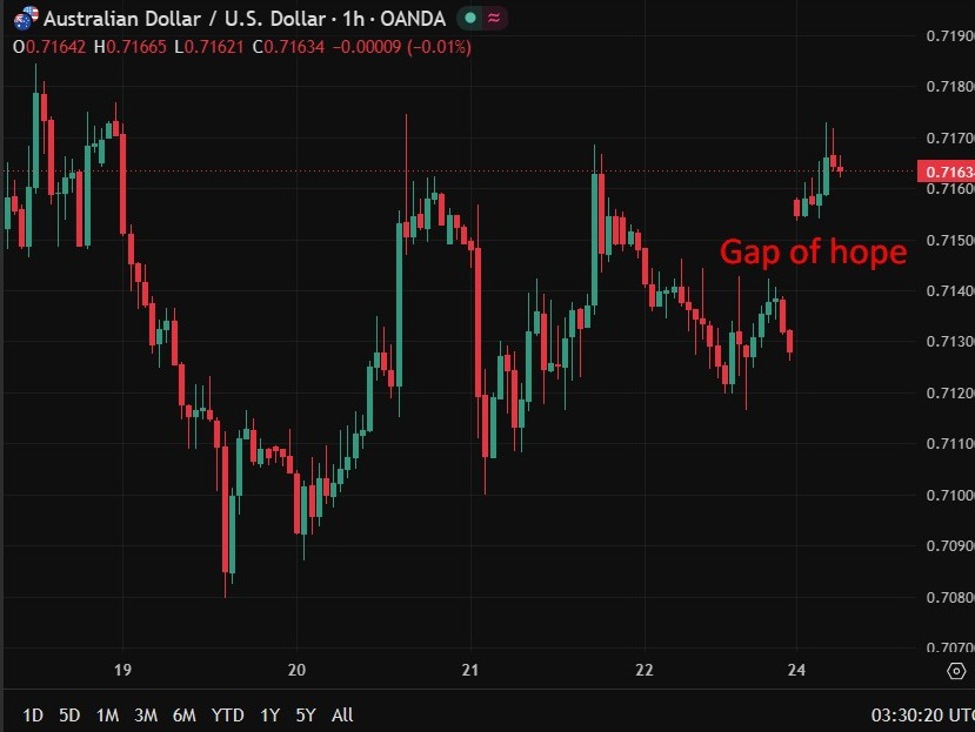
Markets opened the week on a risk-on tone as oil fell below $100 a barrel for the first time in two weeks, S&P 500 futures rose 0.7%, Nasdaq futures gained 1.2%, and spot gold climbed 1.4%. The yuan was fixed at 6.8318 per USD, its strongest reference since February 2023, while the Nikkei cleared 64,000 and then 65,000 for a record high. The move is being driven by Iran-US deal optimism and tentative reopening of Hormuz shipping lanes, though Trump’s comments keep the geopolitical backdrop unsettled.
The market is pricing a de-escalation trade before the policy plumbing is actually complete. That creates a classic asymmetry: near-term risk assets can keep levitating on any incremental easing in shipping disruption, but the first credible reversal in negotiations would hit the same crowded expressions simultaneously — oil down, cyclical Asia up, dollar soft, and duration/tech bid. With holiday-thin liquidity, the second-order risk is that positioning, not fundamentals, drives outsized moves in both directions over the next 1-3 sessions.
The clearest beneficiary is China’s import chain, not just in energy but in freight-sensitive industrials. A stronger yuan fixing alongside easier Gulf transit lowers imported input costs and reduces pressure on local margins, which can briefly help China-sensitive cyclicals and Hong Kong beta; however, the PBOC’s stronger fix also signals tolerance for capital inflow and could make any USD rebound sharper if risk sentiment sours. In other words, the FX move is not just a market signal — it is a policy endorsement that may encourage crowded carry unwinds if geopolitics re-worsen.
For oil, the move below $100 is likely a tactical mean-reversion setup rather than a clean structural break unless transit normalizes. If passages through Hormuz remain partial, inventories will still be drawn unevenly and tanker insurance/spot freight may stay sticky, preserving an embedded risk premium even as outright crude cools. The contrarian miss is that the biggest upside for risk assets may come from lower realized volatility, while the biggest downside comes from a single headline that re-prices shipping bottlenecks faster than physical flows can adjust.
AI-powered research, real-time alerts, and portfolio analytics for institutional investors.
Request DemoOverall Sentiment
mildly positive
Sentiment Score
0.20
Ticker Sentiment
