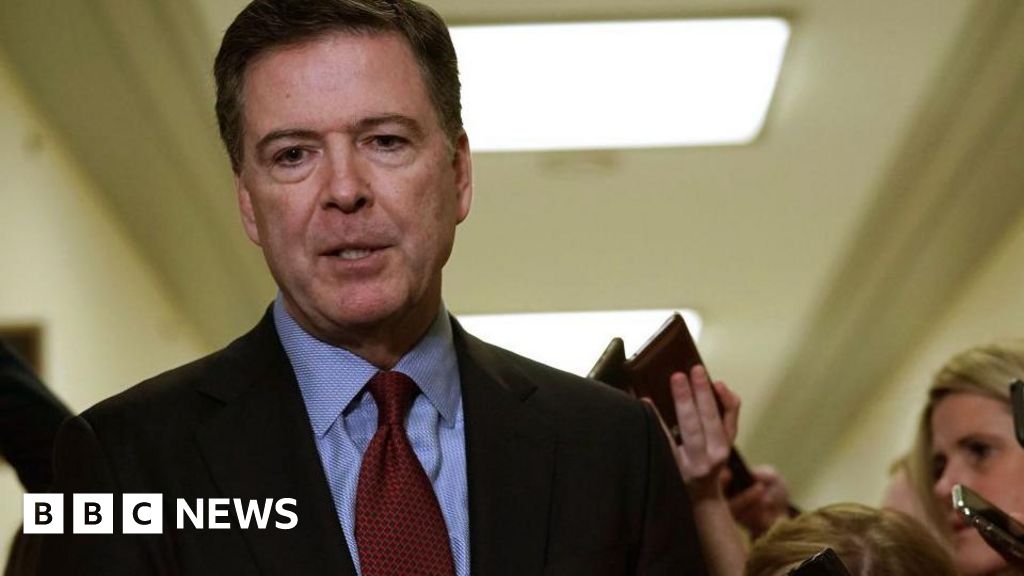
Former FBI Director James Comey surrendered to authorities to face charges alleging he threatened President Trump in an Instagram post referencing "86 47." Prosecutors say each of the two charges carries a maximum 10-year prison sentence, while Comey denies wrongdoing and plans to seek dismissal on selective and vindictive prosecution grounds. The case is politically charged and legally disputed, but it is unlikely to have a material market impact.
This is less a single-case legal event than a signal that politicized enforcement risk is now a tradable regime feature. The immediate market impact is limited, but the second-order effect is an incremental premium for headline-sensitive policy uncertainty: agencies, law firms, media, and politically exposed boards should see a higher expected cost of adverse process, discovery, and reputational spillovers. For equities, the bigger loser is not any direct counterparty here but the institutional trust layer that supports stable regulatory expectations; that tends to widen dispersion between companies with clean governance and those with any latent compliance or political-risk overhang.
The key catalyst is procedural, not substantive. Over the next 2-8 weeks, the case will be driven by motions to dismiss and venue/prosecutorial-validity challenges, meaning the probability-weighted outcome can swing sharply on technical grounds before any merits test. If the defense succeeds on selective/vindictive prosecution or authority defects, the political narrative backfires and reduces the credibility of future enforcement threats; if the case survives, it normalizes a lower evidentiary bar for politically charged actions, which could raise the discount rate on government-sensitive assets for months.
The contrarian read is that the market may be underpricing the institutional backlash risk. Even observers sympathetic to aggressive prosecution can see the case as legally brittle, which increases the odds of a short-term win for the defense and a medium-term loss for the administration's enforcement agenda. That creates asymmetry: the headline is negative for civic stability, but the more investable trade may be a fade of any assumed 'law-and-order' premium if the case weakens quickly and becomes an embarrassment rather than a deterrent.
AI-powered research, real-time alerts, and portfolio analytics for institutional investors.
Request DemoOverall Sentiment
mildly negative
Sentiment Score
-0.30
