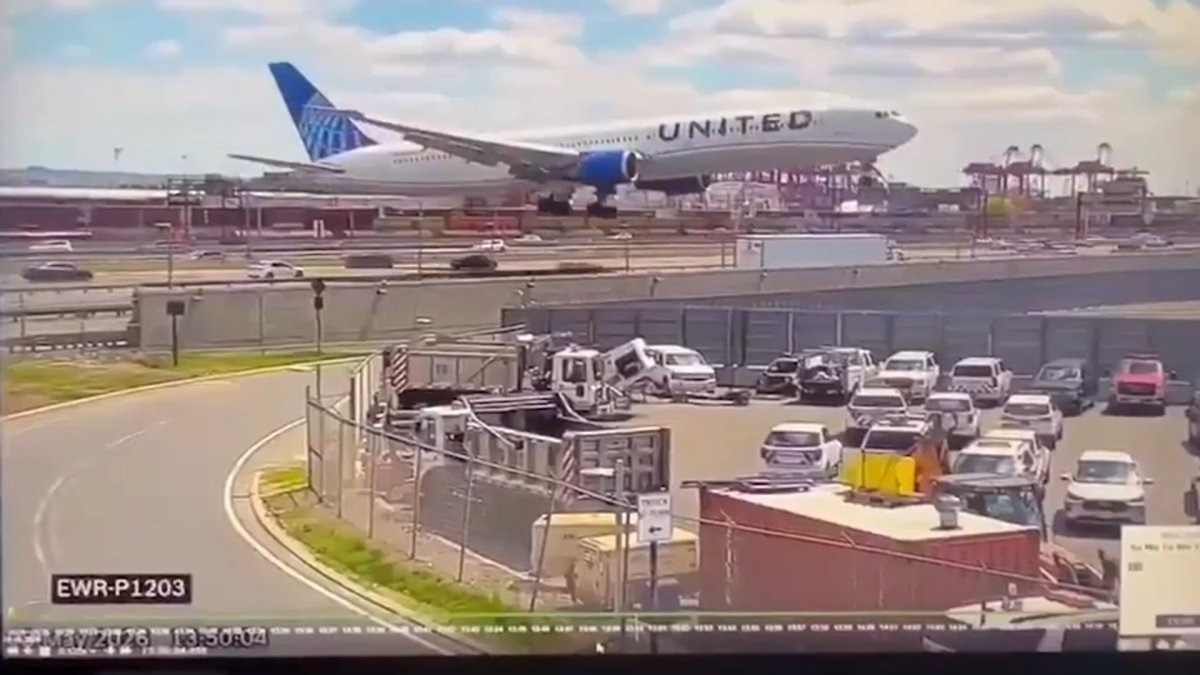
A United Airlines Flight 169 carrying 231 people clipped a bakery company tractor-trailer and a light pole on final approach into Newark, damaging both the plane and the truck. No passengers or truck driver suffered serious injuries, but the NTSB has classified the event as an accident and, along with the FAA, is investigating. United has pulled the crew from service pending a rigorous safety review.
The immediate read-through is not to model direct earnings damage, but to treat this as an operational-risk event with asymmetric downside to sentiment. UAL’s exposure is mainly in the next 1-4 weeks: regulators will likely widen scrutiny on Newark operations, and any temporary tightening of arrival rates, runway sequencing, or crew availability can create disproportionate knock-on effects in completion factor and unit costs. In an environment where investors are already sensitive to reliability at constrained Northeast hubs, even a low-probability safety event can compress the multiple faster than it hits the P&L.
Second-order winners are the local disruption hedges: airport service providers, rivals with less Newark concentration, and any carrier with incremental share to absorb diverted premium traffic if schedules get re-optimized. The bigger medium-term issue is that this could feed into a broader narrative around congestion, air traffic control capacity, and aging ground/airside infrastructure, which raises the odds of incremental capex or slot/flow restrictions rather than a one-off headline. That matters because infrastructure bottlenecks usually take months to unwind and can create persistent network inefficiency before any headline recovery appears.
The contrarian angle is that the move may be over-discounting legal tail risk and underpricing operational resilience. Unless the investigation identifies a systemic training or maintenance issue, the financial impact should be contained to a short-lived sentiment hit and some avoidable disruption costs, not a durable earnings impairment. The key risk is not the accident itself but follow-on evidence of procedural failure; if that emerges, the market will re-rate UAL as a governance/liability story for several quarters instead of a transient headline event.
AI-powered research, real-time alerts, and portfolio analytics for institutional investors.
Request DemoOverall Sentiment
mildly negative
Sentiment Score
-0.15
Ticker Sentiment
