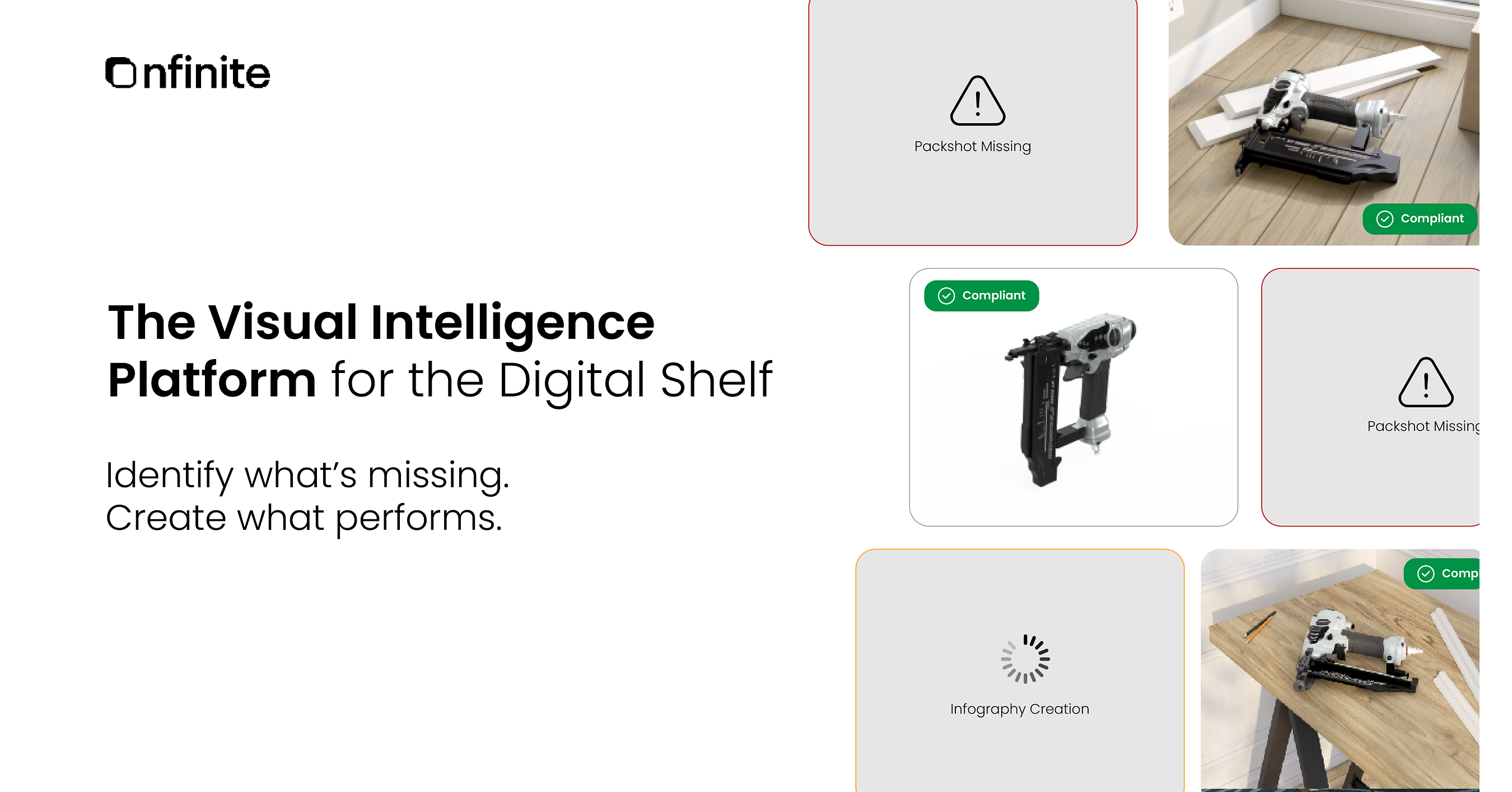
Nfinite lance une plateforme d’intelligence visuelle pour rayons virtuels afin d’optimiser la qualité et la conformité des visuels produits à grande échelle. L’article cite un cas où une grande marque de bricolage atteint 61% de conformité (897 défauts) et souligne que les pages non conformes peuvent coûter 15–25% de chiffre d’affaires, tandis que l’IA générative réduit les coûts de production de 70–95%. Le message est globalement positif, mais sans impact financier chiffré direct pour Nfinite dans l’annonce.
This is more important as an operating-systems story than as a standalone product launch. If catalog quality becomes continuously measurable, the advantage shifts to retailers and brands with the most SKUs, the most private-label exposure, and the highest traffic leverage on small conversion lifts — think AMZN, WMT, HD, and LOW. The second-order winner is not the company that can generate the cheapest image, but the one that can triage which missing asset actually moves revenue; that favors scaled commerce platforms and penalizes manual merchops/BPO workflows that monetize labor hours.
Near term, I would not expect this to matter for public equities until there is proof of workflow integration and paid adoption. The key catalyst path is 1-3 months: named pilots, integration into PIM/DAM stacks, or retailer-side commentary that visual compliance is being tied to conversion or search rank. Over 6-18 months, the structural implication is budget rotation from headcount-heavy content remediation toward software that reduces vendor friction; that is constructive for commerce software, but only if it can sit inside existing approval pipelines rather than living as another dashboard.
Contrarian view: the market may overestimate how much of the problem is solved by AI generation and underestimate governance friction. The hard constraint is not producing more assets, it is getting retailers to accept, classify, and surface them correctly across channels; if that fails, the value capture stays defensive rather than expansionary. Thesis is falsified if adoption remains a proof-of-concept after two quarters or if customers cannot show measurable lift in conversion, indexing, or content-compliance cost reduction versus baseline merch ops.
AI-powered research, real-time alerts, and portfolio analytics for institutional investors.
Request DemoOverall Sentiment
mildly positive
Sentiment Score
0.25
