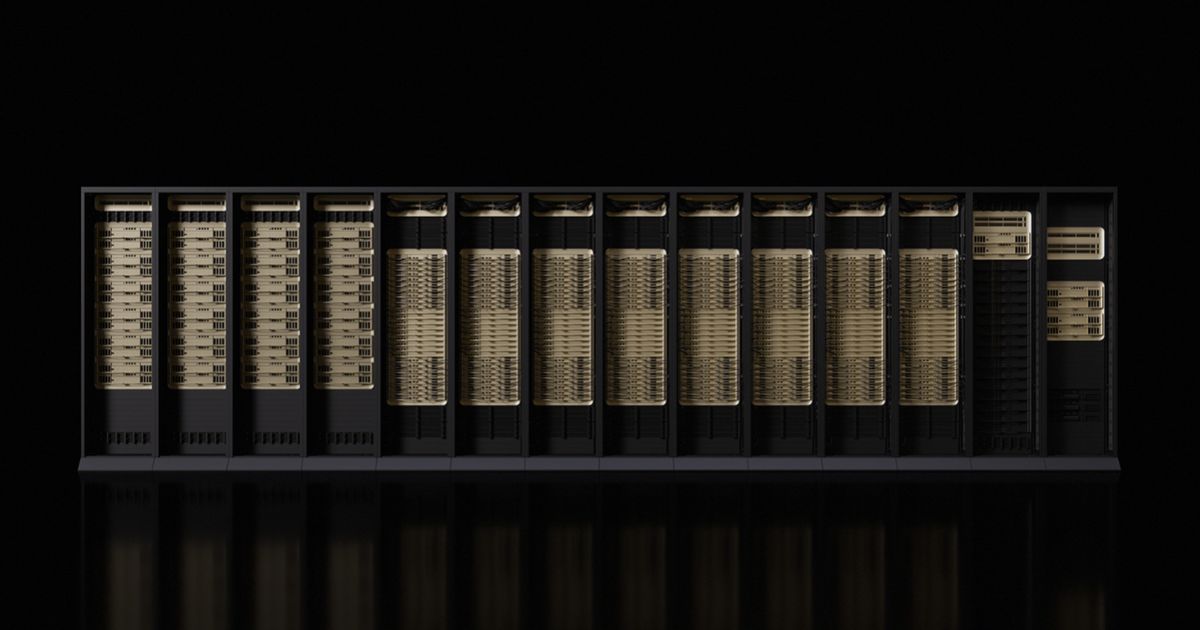
Nvidia has halted production of H200 chips destined for China and redirected TSMC capacity to its next‑generation Vera Rubin platform, confirming management's earlier guidance that it is not assuming any China data‑centre revenue. The company reported record Q4 revenue of $68.1 billion (up 73% YoY) and FY revenue of $215.9 billion (up 65%), with data centre sales of $62.3 billion and Q1 guidance of $78 billion (versus $72.6 billion consensus). The decision reflects regulatory and commercial constraints—US export controls, Beijing's import conditions and limited TSMC 3nm capacity—and shifts confirmed orders for Rubin (3nm, ~50 petaflops inference) ahead of conditional H200 (4nm Hopper) demand that never shipped. Investors should view this as a reallocation toward higher‑margin, confirmed western hyperscaler demand and away from a politically risky China market.
Market structure: Nvidia (NVDA) and TSMC (TSM) are clear winners — NVDA gains pricing power and demand visibility by reallocating scarce 3nm wafers to Vera Rubin (platform tied to ~$500bn+ hyperscaler orders), while TSM captures higher-margin 3nm utilization. Chinese AI training buyers and mid-tier exportable-hardware vendors are losers; expect a widening performance gap (Rubin ~22x vs export-compliant chips) that forces Chinese buyers to either pay a premium on secondary markets or accelerate domestic fabs.
Risk assessment: Near-term (days–weeks) tail risks include PRC policy reversal or a last-minute import approval that could create one-time H200 shipments and entropy in NVDA sales cadence; medium-term (3–12 months) risk is TSMC yield/expansion delays that compress NVDA/TSM margins. Hidden dependencies include ASML/EUV tool lead times and wafer substrate constraints — a 5–10% slip in TSMC 3nm output materially alters 2026 revenue timing. Key catalysts: hyperscaler deployment announcements (H2 2026), PRC Commerce rule details (30–60 days), and TSMC capacity guidance (next quarterly report).
Trade implications: Tactical bias long NVDA and TSM, overweight cloud hyperscalers (MSFT, ORCL, CRWV) into H2 2026 deployments; prefer defined-risk option structures to capture H2 demand realization. Consider pair trades: long NVDA vs short China-tech exposure (e.g., KWEB) to isolate regulatory tail. Rotate away from China-exposed semiconductor hardware names and reallocate to US/EU data-centre capex beneficiaries.
Contrarian angles: Consensus underestimates the probability of PRC countermeasures (forced local buy) that could temporarily depress western cloud economics but accelerate Chinese capex into domestic fabs — a multi-year boost for ASML/TSM supply-chain winners and long-term competitor emergence. Market may be underpricing the multi-year demand for 3nm+ capacity: if Rubin deployments track Jensen’s guidance, NVDA upside into late-2026 could be larger than current multiples imply.
AI-powered research, real-time alerts, and portfolio analytics for institutional investors.
Request TrialOverall Sentiment
moderately positive
Sentiment Score
0.60
Ticker Sentiment
