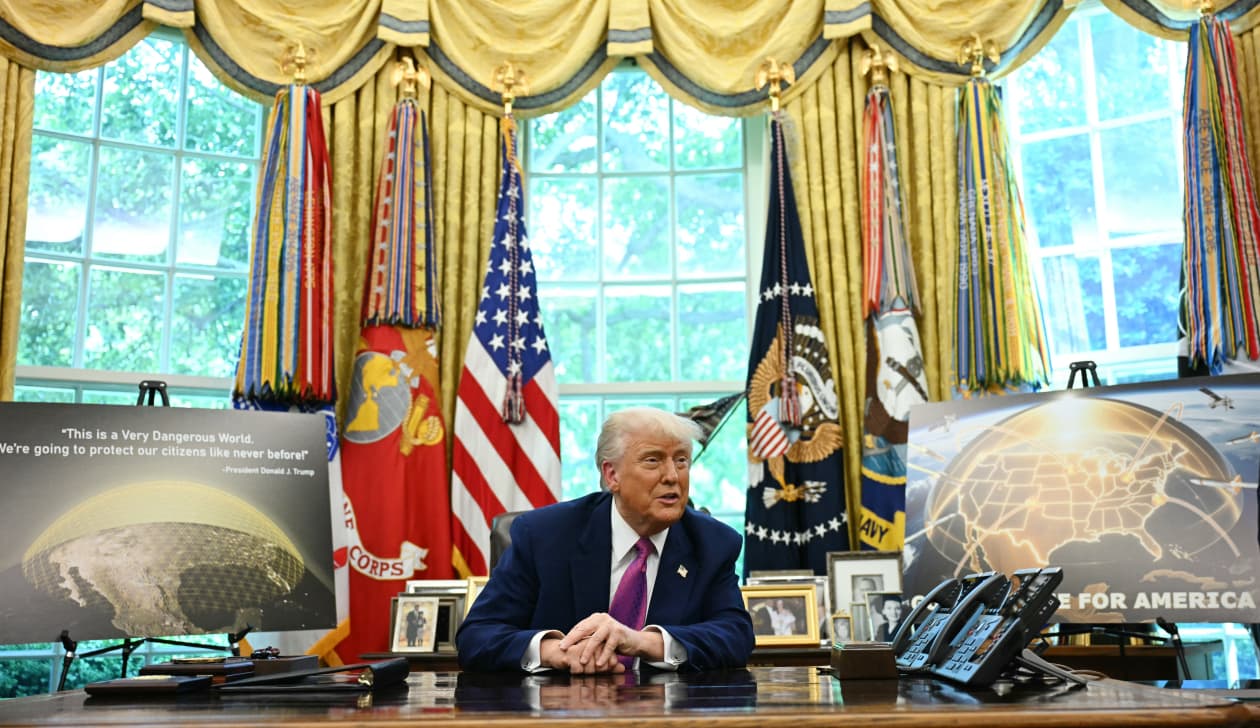
Anduril completed a funding round at a $61 billion valuation, making it the 12th-most valuable private company and signaling continued investor confidence in defense-tech. The company is helping build President Trump’s 'Golden Dome' antimissile shield, reinforcing its strategic position in infrastructure and defense. CEO Brian Schimpf also indicated an IPO is coming, adding a near-term public-market catalyst.
This is less about one private valuation and more about the re-pricing of defense as a software-defined, venture-scale category. A $61B mark implies public-market investors are likely to extrapolate a much larger addressable market for autonomy, sensors, electronic warfare, and command-and-control than traditional primes can credibly capture on their own. The second-order winner is the supplier stack behind fast iteration: advanced semis, optical components, industrial compute, and test equipment could see sustained demand as defense procurement shifts from platform-heavy to software-upgradable architectures.
The key market implication is that the IPO pipeline for defense-tech just got a higher reference point, which can lift private secondary prices and force a re-underwriting of comparable names over the next 6-18 months. But the enthusiasm is fragile: these businesses often look amazing in the two years before revenue recognition, then face the grind of production scale, contract timing, and customer concentration. Any delay in program awards, export approvals, or Congressional funding could compress the valuation gap quickly, especially if the company’s growth story depends on a narrow set of large programs.
The overlooked risk is crowding. If capital rotates into “national security AI” as a thematic basket, it may bid up the wrong beneficiaries first—companies with the cleanest narratives rather than the strongest backlog conversion. That creates a setup where the best public-market expression is not necessarily the obvious prime, but the picks-and-shovels names tied to procurement cadence and electronics content. If the macro environment shifts toward easing geopolitical urgency or a budget resolution disappoints, the multiple expansion can reverse faster than the underlying contracts roll off.
AI-powered research, real-time alerts, and portfolio analytics for institutional investors.
Request DemoOverall Sentiment
moderately positive
Sentiment Score
0.45
