
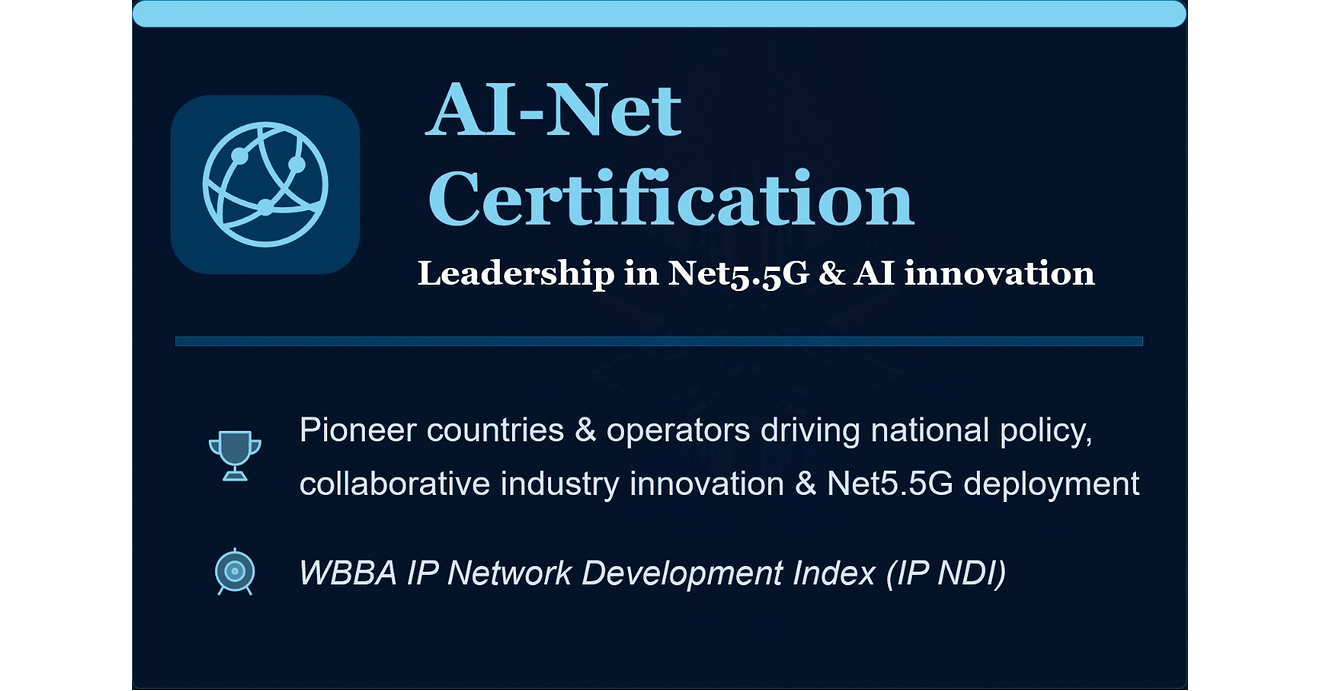
La World Broadband Association (WBBA) lance officiellement AI-Net, une certification mondiale de communication de données destinée à accélérer la transition des réseaux vers la Net5.5G et l’« IA généralisée ». Le cadre repose sur trois piliers (orientation stratégique nationale, écosystèmes collaboratifs du secteur, taux de pénétration Net5.5G) et vise à harmoniser politiques et maturité technologique avec des mesures quantifiables via l’IPDI. L’annonce est surtout structurante pour l’industrie (réseaux “Network for AI” et “AI for Network”), avec un impact direct limité à court terme sur les marchés boursiers.
This is less a revenue event than a procurement signal. The only investable edge is if AI-Net becomes a shorthand in carrier and sovereign tender language, which would advantage vendors already positioned around deterministic low-latency fabrics and network automation; that favors ANET, AVGO, CSCO, and potentially HPE over legacy, hardware-heavy telecom stacks. The second-order effect is vendor concentration: once a certification defines “good” network architecture, smaller regional suppliers tend to lose share because operators prefer pre-validated platforms over custom integration.
Near term, I would not assume meaningful P&L impact for operators or equipment vendors; certifications usually lead capex by 2-4 quarters, and only if they are embedded into funding programs or regulatory scorecards. The key catalyst is whether APAC governments or large carriers explicitly reference the standard in RFPs, spectrum buildouts, or national AI infrastructure plans. Falsifiers are simple: if the next two earnings cycles show no change in order commentary, backlog, or carrier capex budgets, the market should fade the narrative.
The contrarian view is that this may be mostly branding around an existing upgrade cycle. Consensus will likely overread the announcement as a secular AI networking accelerant, but the real driver remains data-center and carrier capex budgets, not certification language. The underappreciated upside is on operating efficiency: AI-native network management can improve gross margins for vendors with software/telemetry attach, while pressuring services-heavy integrators and weaker regional router/radio vendors that cannot pass through compliance costs.
AI-powered research, real-time alerts, and portfolio analytics for institutional investors.
Request TrialOverall Sentiment
mildly positive
Sentiment Score
0.25
Ticker Sentiment
