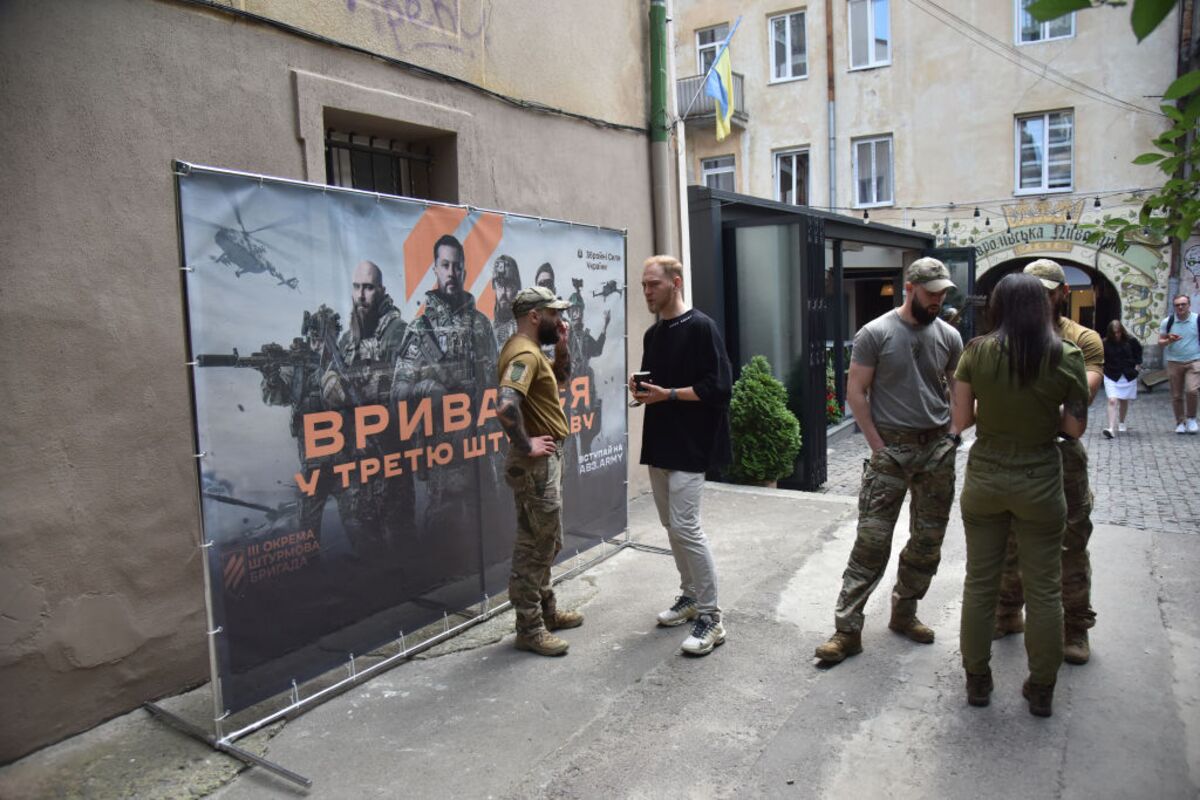
Attacks on Ukrainian draft officers are rising as war fatigue deepens, with a recent incident in Lutsk showing youths intervening to help a detainee escape. The article highlights growing public resistance to mobilization amid prolonged conflict with Russia. This is negative for Ukraine’s domestic stability and war effort, but likely limited direct market impact.
This is less a tactical security story than a signal that Ukraine’s mobilization capacity is becoming a binding constraint. The second-order risk is not just fewer recruits, but a slower, more fragmented force-generation pipeline that increases the probability of manpower dilution, lower unit quality, and higher desertion over the next 3-9 months. That tends to push up the implicit cost of sustaining the front: more rotation pressure, greater reliance on older cohorts, and a higher chance that Kyiv has to choose between preserving legitimacy at home and preserving force density at the front.
The market implication is that anything tied to a rapid, steady attritional war becomes more fragile. Defense beneficiaries may still win at the headline level, but the mix shifts toward consumables, drones, EW, and air defense rather than platforms that depend on a stable procurement cycle. At the same time, domestic political stress inside Ukraine raises the odds of policy discontinuities: tighter enforcement, exemptions, or administrative reshuffles that can briefly improve morale but also expose the state’s limited coercive bandwidth.
The contrarian angle is that this can be misread as imminent collapse. In practice, coercive mobilization problems often generate a lagged response: localized backlash first, then institutional adaptation, then a new equilibrium. So the near-term trade is not “Ukraine loses tomorrow,” but that the probability distribution widens around outcomes where the war becomes more manpower-constrained and politically volatile, which is bearish for any asset assuming linear continuation of current support levels.
Key catalyst windows are the next 4-12 weeks, when recruitment enforcement and public messaging either stabilize or further degrade. A reversal would require visible battlefield gains, a new mobilization framework with better exemptions/incentives, or stronger external manpower support; absent that, fatigue compounds into a medium-term operational headwind.
AI-powered research, real-time alerts, and portfolio analytics for institutional investors.
Request TrialOverall Sentiment
moderately negative
Sentiment Score
-0.45
