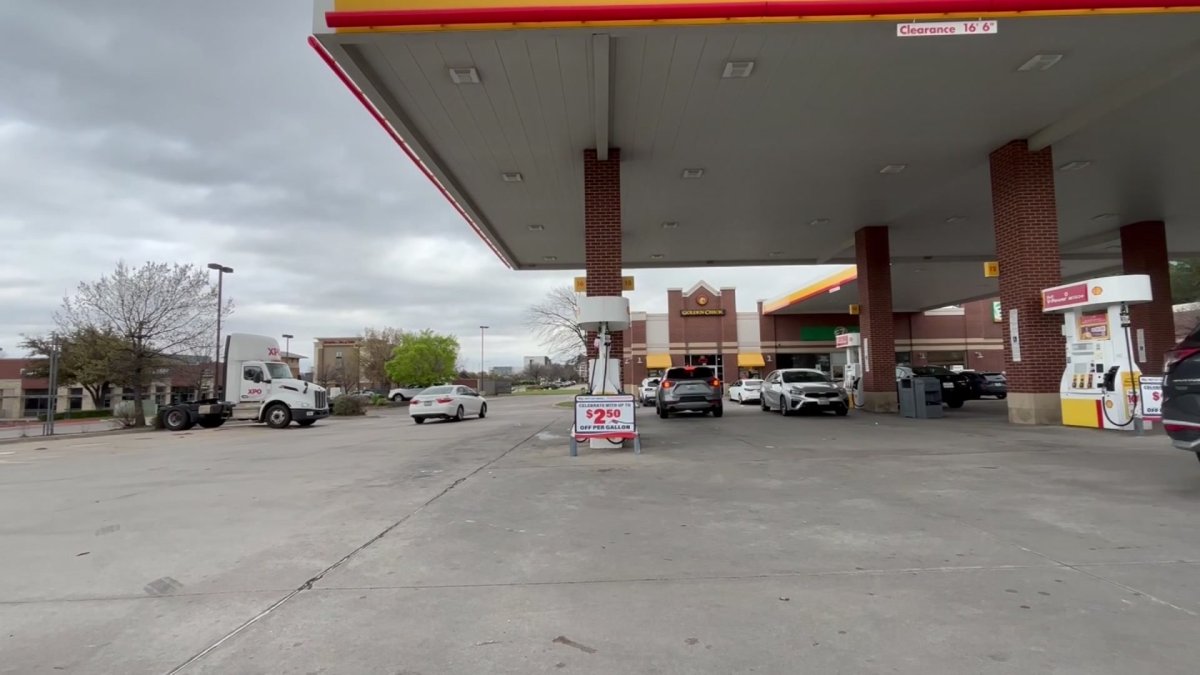
Average regular unleaded in the Dallas–Fort Worth area was $3.19/gal early Monday, up $0.57 (+21.8%) from $2.62 one week earlier; some Dallas stations hit $3.49 and Dallas County averaged $3.36. The pump spike is attributed to rising crude — which briefly reached $118/barrel before settling just under $100 — and heightened geopolitical risk around Iran and the Strait of Hormuz, which could further pressure fuel and transport costs. Prices remain well below the June 2022 North Texas record of $4.84/gal, but AAA and local industry groups warn of continued upside risk that could flow through to travel and consumer goods.
Recent upward moves in pump prices are best thought of as a risk-premium re-pricing rather than a pure demand shock. Small disruptions to key sea lanes or security-related insurance surcharges can add a measurable cost to delivered crude — typically on the order of $1–4/bbl in insurance and $1–3/bbl in rerouting/voyage-costs when long detours add 7–14 days — which passes through nonlinearly into retail gasoline margins and crack spreads.
That transmission creates asymmetric winners and losers across the value chain. Refiners with Gulf Coast exposure and flexible feedstock intake capture outsized gains in the gasoline crack on a sustained price dislocation, while airlines and long-haul trucking face margin compression that shows up as higher unit costs within weeks. At the macro level, a sustained $10/bbl shift in oil prices historically adds roughly 0.1–0.2 percentage points to headline inflation over 6–12 months, a tailwind to real-rate-sensitive assets and a headwind to discretionary consumption if the move persists.
Near-term catalysts are news-driven and operate on days-to-weeks timelines; medium-term outcomes (months) depend on policy responses: SPR releases, coordinated producer output increases, or demand destruction as consumers and businesses substitute away. A plausible reversal sequence is rapid diplomatic or supply-side easing that compresses the risk premium within 30–60 days; absent that, expect margin reallocation across transport, retail, and refining to persist into the summer travel season.
AI-powered research, real-time alerts, and portfolio analytics for institutional investors.
Overall Sentiment
mildly negative
Sentiment Score
-0.25
