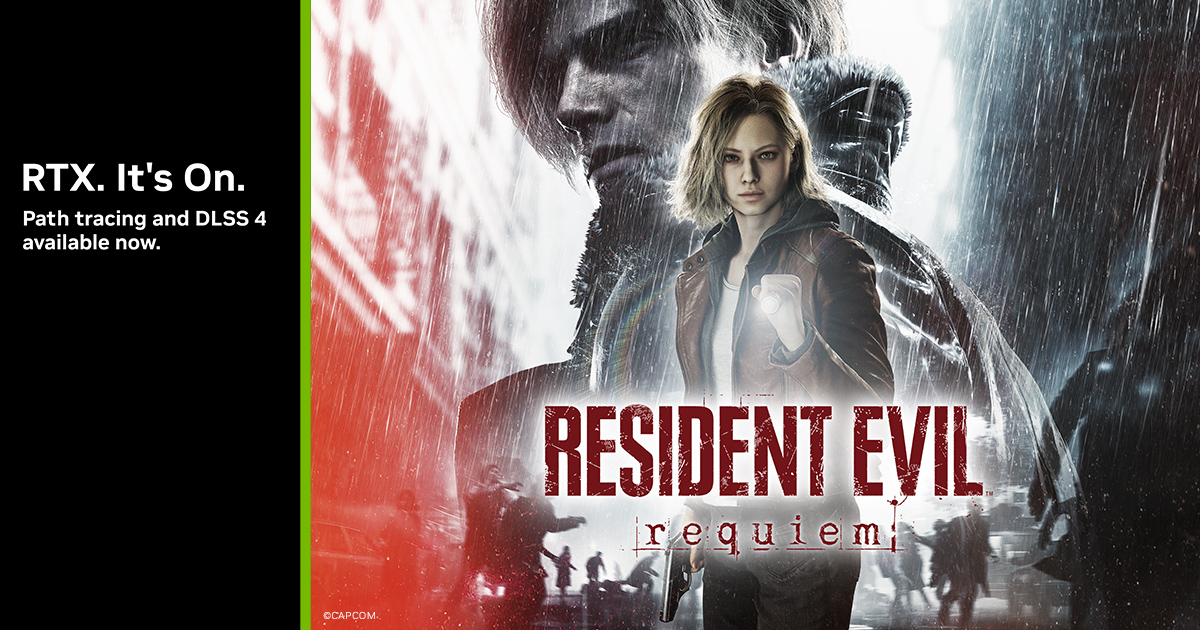
Capcom’s Resident Evil Requiem launched on Steam with advanced visual features (path tracing, DLSS Ray Reconstruction, DLSS 4 with Multi Frame Generation and NVIDIA Reflex) and OEM/promotional bundling tied to NVIDIA GeForce RTX 50 Series GPUs and select 40 Series features. NVIDIA cites performance targets — e.g., RTX 5090 >280 FPS at 4K (with 4X DLSS 4) and 340 FPS at 2560x1440, RTX 5080 ~200 FPS at 4K — and a 46% PC latency reduction via Reflex; limited-time bundle and OEM giveaway promotions aim to drive RTX 50 Series demand and system sales. Investors should view this as a product-marketing catalyst that could modestly support GPU and OEM sales momentum, but it is unlikely to be a material market-moving event on its own.
Market structure: NVIDIA (NVDA) is the clear direct beneficiary — the RTX 50-series + DLSS4 bundle materially reinforces NVDA’s premium at the high-end GPU price point and raises ASPs near term; AIB partners (Gigabyte, MSI, Zotac) and TSMC (TSM) benefit from higher fab utilization, while AMD (AMD) and Intel (INTC) face pressure in discrete GPU share and pricing. Supply constraints (TSM capacity for N4/N3) combined with strong launch demand imply tighter supply/demand for top-bin GPUs over the next 2–6 quarters and upward pressure on prices/ASP by ~5–15% vs typical refresh cycles.
Risk assessment: Tail risks include US export controls or Chinese import retaliation (low probability, high impact), TSMC production disruption, or slower developer adoption of DLSS4/path-traced titles; any of these could wipe out a >20% revenue premium for NVDA within 3–12 months. Immediate (days) effects will be sentiment-driven around bundle redemption data; short-term (weeks–months) depends on sell-through and OEM channel inventory; long-term (1–3 years) hinges on software ecosystem adoption and data-center GPU demand.
Trade implications: Direct trade — establish a 2–3% long NVDA equity position targeting +15–25% in 3–6 months with an 8% stop; add 1–2% long TSM to play foundry leverage. Options — prefer a 3-month NVDA bull call spread 8–15% OTM (debit) sized to 0.5–1% portfolio if IV < 85th percentile; if NVDA rallies >15% in 30 days, sell 1–2% covered calls or set up a bear call spread. Pair trade — long NVDA / short AMD (0.6:0.4 notional) to capture likely share shift in discrete GPUs over 6–12 months.
Contrarian angles: The market may be over-pricing immediate, sustainable uplift — path tracing is compelling but niche; broad studio adoption typically lags hardware by 6–18 months, so bundle-driven revenue could be front-loaded and followed by a softness in FY+1. Historical parallel: RTX 20-series hype produced short-term excitement but delayed mass DXR adoption until the 30-series; if NVDA >15% above current levels in 30 days, consider trimming or selling call spreads to monetize potential mean reversion and front-loaded demand.
AI-powered research, real-time alerts, and portfolio analytics for institutional investors.
Request DemoOverall Sentiment
mildly positive
Sentiment Score
0.28
Ticker Sentiment
