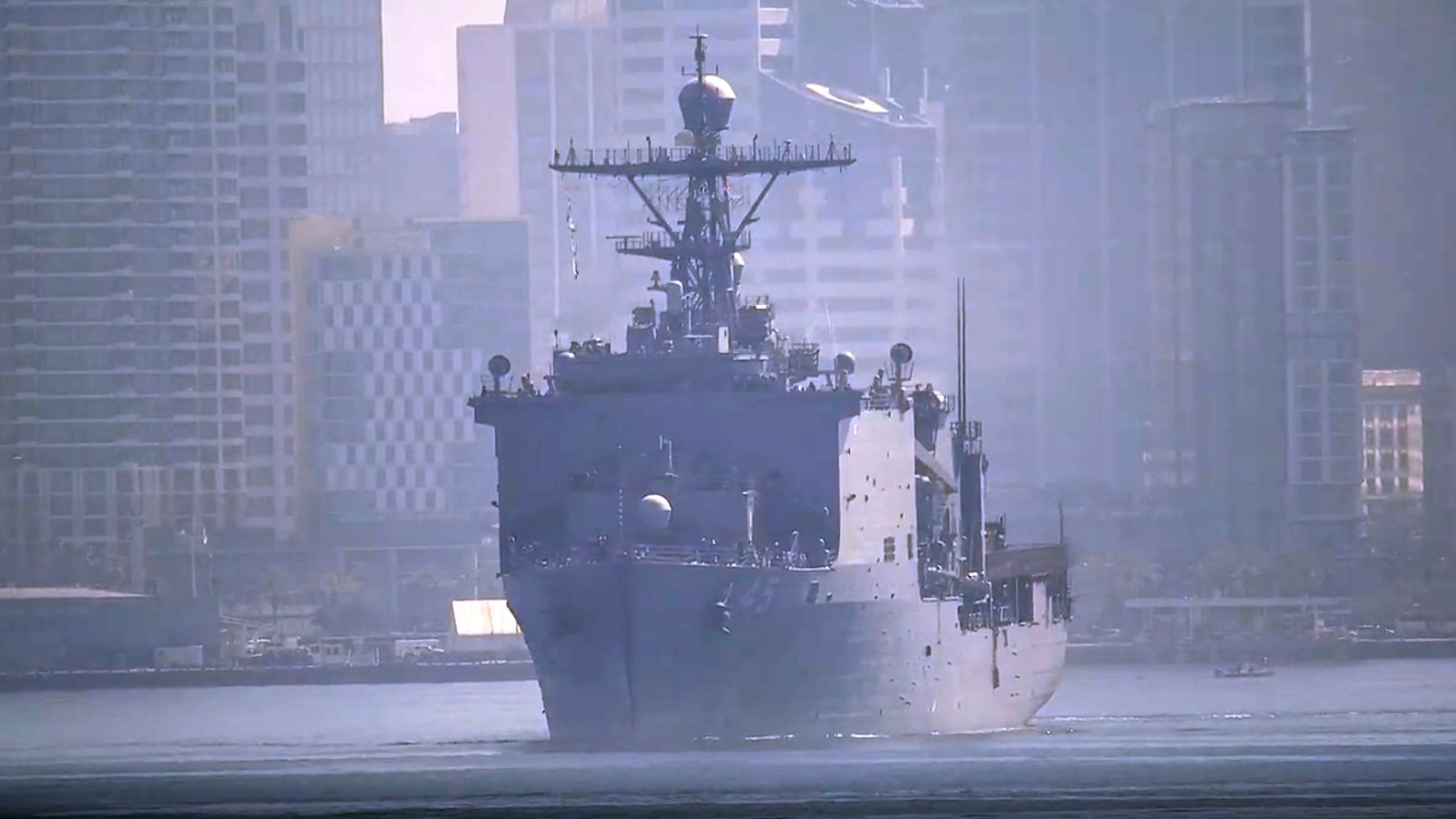
2,200 Marines aboard three Navy ships (USS Boxer, USS Comstock, USS Portland) left San Diego and could be ordered to the Middle East, a move that in combination with the 31st MEU would amount to nearly 9,000 additional forces in the region. If redirected, transit could take weeks (USS Boxer ~2 weeks to Southeast Asia plus additional time to transit to the Middle East); the 11th MEU includes ground, logistics and aviation assets (fighter jets, MV-22 Ospreys, attack helicopters). The deployment raises geopolitical risk around the Persian Gulf—including speculation about operations at Kharg Island or near the Strait of Hormuz—which could pressure oil markets and increase regional escalation risk. For now, U.S. 3rd Fleet characterizes the 11th MEU activity as routine Indo‑Pacific operations.
A small but credible surge of amphibious forces increases the probability that energy and marine insurance markets will re-price geopolitical risk before physical flows are affected — insurance and war-risk premia typically move in hours, while actual tanker reroutes and crude reallocation take days-to-weeks. Expect the largest immediate market impact to be on short-dated Brent/WTI spreads and tanker time-charter rates rather than long-run production fundamentals; front-month futures will concentrate most of the move within 2–6 weeks if incidents or harassment near chokepoints occur.
Second-order winners are shipyards, expeditionary logistics contractors, and defense suppliers whose backlog and urgent spare-part orders can convert to near-term revenue; expect contract acceleration and premium overtime/expedited parts demand over 3–12 months. Conversely, refiners reliant on tight Asian Gulf supply and cargo owners facing higher war-risk premiums see margin compression — a reroute around Africa can add roughly a week of voyage time and raise per-barrel shipping cost on VLCCs by a non-trivial amount, pressuring refined product spreads regionally.
Market microstructure offers a faster edge in freight and insurance instruments than in equities: spot tanker rates and war-risk insurance attach first, then oil and equities follow. The principal reversal catalyst is diplomatic de-escalation or credible escorts that remove the risk premium — those outcomes typically reduce spreads within 7–30 days, so trades should be sized and timed to reflect a likely short-lived volatility window.
AI-powered research, real-time alerts, and portfolio analytics for institutional investors.
Request DemoOverall Sentiment
neutral
Sentiment Score
0.00
Tail risks: an actual interdiction or strike on energy infrastructure would propagate to a >$5/bbl spike and sustained tanker-rate dislocations for months; alternatively, an uneventful show-of-force that achieves deterrence will produce a sharp mean-reversion. Monitor war-risk premiums, VLCC/AFRICA voyage times, and near-dated Brent front-month/back-month curve steepening as the high-frequency signals that separate noise from persistent regime change.
