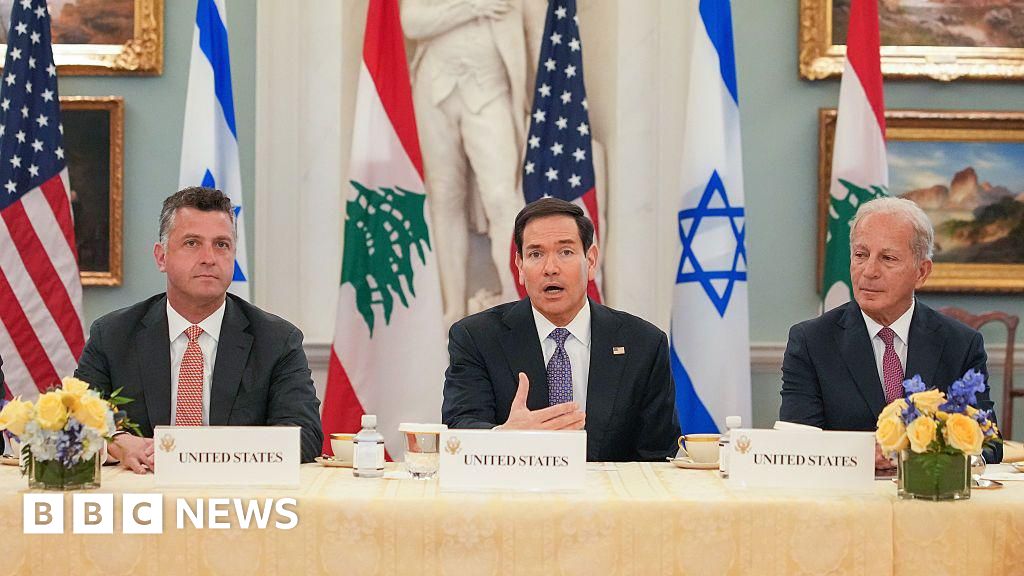
Israel and Lebanon held their first direct talks since 1993 amid an ongoing conflict that has killed more than 2,000 people and displaced about 1 million. The discussions center on a possible ceasefire, Hezbollah disarmament, and preventing a renewed Israeli occupation of southern Lebanon, but no immediate outcome is expected. The geopolitical risk remains high as Hezbollah continues attacks and the US says the talks are unrelated to negotiations with Iran.
This is less a ceasefire headline than a regime-change signal: if direct Israel-Lebanon channel capacity improves, the marginal probability of a broader northern-front escalation falls, which should compress risk premia embedded in regional energy, shipping, and defense supply chains over the next 2-8 weeks. The immediate market impact is more about tail-risk repricing than earnings, because the path to implementation runs through non-state compliance, not state signatures. That means any relief rally is likely to be choppy and vulnerable to headline reversals rather than a clean trend.
The key second-order issue is Hezbollah’s incentive to prove irrelevance by demonstrating optionality on the battlefield, so tactical attacks may increase before any durable de-escalation. That creates a near-term asymmetry: downside for “hot conflict” hedges if the diplomacy sticks, but upside convexity if negotiations fail and Israel broadens operations southward again. In practice, the next catalyst window is days, not months: any violation/rocket response can reset the tape, while a sustained lull for 2-3 weeks would begin to unwind the geopolitical premium more meaningfully.
The contrarian angle is that the market may already be too anchored on the notion of permanent escalation in the Levant, when the more durable outcome could be a constrained, localized security arrangement that is bearish for defense urgency and bullish for reconstruction optionality. However, a full disarmament outcome is unlikely in the medium term; the more plausible base case is deconfliction and a partial redeployment that reduces kinetic intensity without solving the underlying sovereignty problem. Investors should therefore fade binary ceasefire euphoria and instead trade the spread between near-term de-escalation and long-run fragility.
AI-powered research, real-time alerts, and portfolio analytics for institutional investors.
Request TrialOverall Sentiment
strongly negative
Sentiment Score
-0.70
