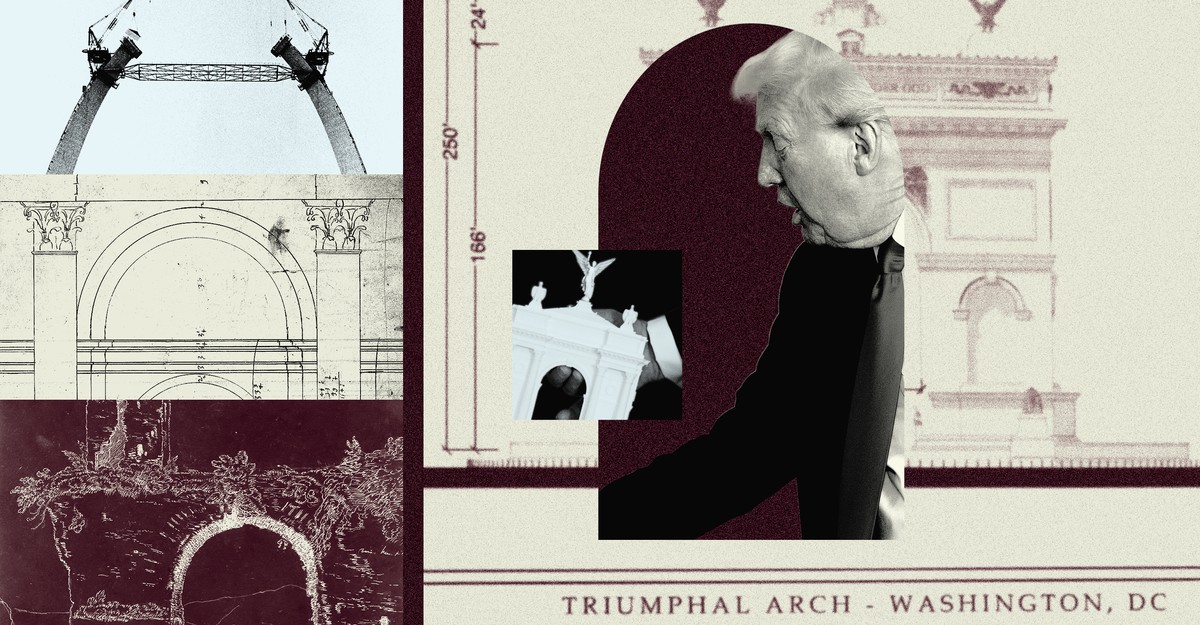
The article criticizes President Trump’s proposed 250-foot arch across from Washington, D.C., arguing it represents personal glorification rather than republican civic values. The project has already been approved by the U.S. Commission of Fine Arts and is set to go before the National Capital Planning Commission in June, but the piece frames it as politically controversial rather than economically material. Market impact is limited, with the main relevance centered on government approvals, public monument planning, and domestic political symbolism.
This is less a construction story than a governance signal: the market should read it as another data point that federal permitting, review boards, and capital allocation are increasingly personalized. The second-order effect is not on any single contractor but on the broader policy premium embedded in D.C.-linked infrastructure, defense-adjacent symbolism, and any business exposed to discretionary federal aesthetics, where process risk is now more important than budget line items. That tends to favor incumbents with clean procurement exposure and hurt firms/consultancies dependent on political access rather than execution.
The bigger investable takeaway is reputational and institutional drift. When public works are perceived as vanity projects, the discount rate rises for adjacent initiatives: congressional scrutiny, municipal pushback, and litigation risk all increase the probability of delay, redesign, or cancellation. In practice, that means a longer decision cycle for Washington-area real estate, civil works, and federal-facing architecture/engineering firms, even if headline spending remains unchanged.
The contrarian angle is that the market may underprice the durability of performative projects because they often survive exactly due to their symbolism. A project framed as identity politics can draw donations, vendor interest, and media attention, which reduces the usual fiscal discipline that would otherwise kill low-utility capex. So the trade is not to short the concept outright, but to fade the beneficiaries most exposed to schedule slippage and legal challenge while staying long names that monetize bureaucracy regardless of which project gets built.
AI-powered research, real-time alerts, and portfolio analytics for institutional investors.
Request DemoOverall Sentiment
mildly negative
Sentiment Score
-0.20
