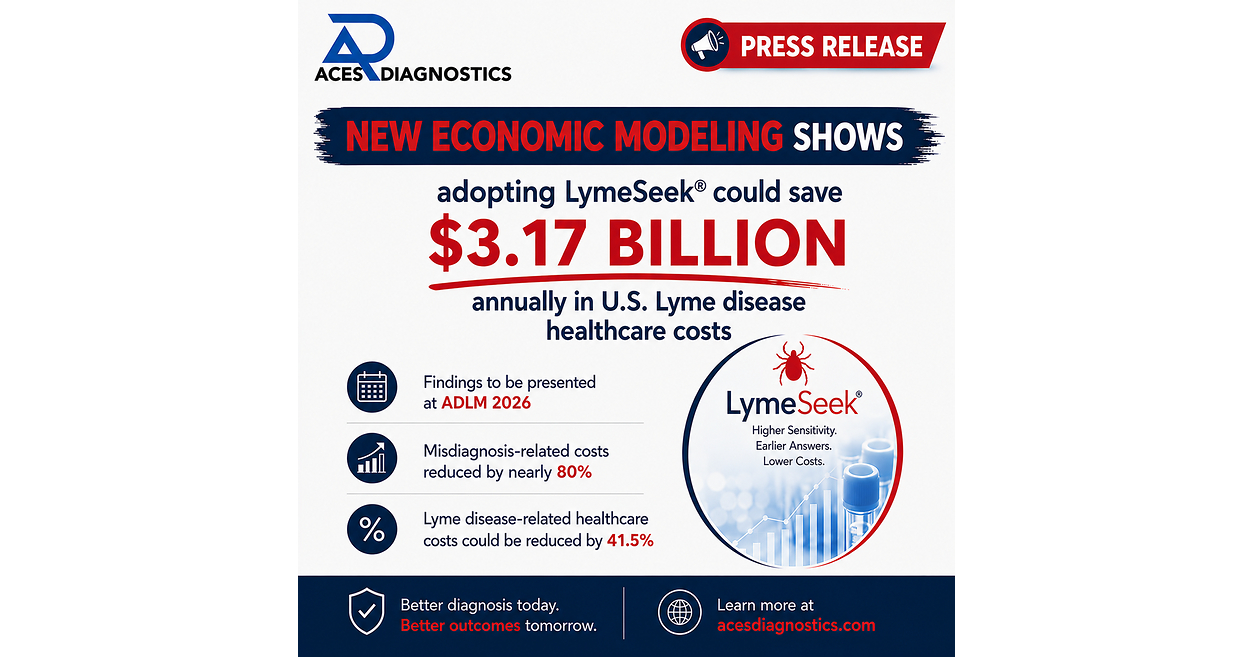
Aces Diagnostics said an independent health economics analysis found its higher-sensitivity Lyme test, LymeSeek, could cut annual U.S. Lyme-related healthcare costs by 41.5% to $4.48B from $7.65B. Misdiagnosis-related costs are projected to fall 79.53% (from $6.05B to $1.24B), driven by more than doubling early localized-stage detection (+105.06%) and reducing false negatives by 79.65%. The data will be presented at ADLM 2026 on July 27, with the abstract published in an ADLM journal.
This is primarily a reimbursement-and-adoption story, not an immediate revenue event. The economic upside only matters if payers accept that the better test changes downstream utilization enough to justify broader coverage; without coding, physician workflow integration, and guideline support, the model remains a slide deck rather than P&L.
The clearest winners are large reference labs and diagnostic workflow owners that can absorb a niche assay into an existing sales channel, while the losers are incumbent serology workflows and the downstream spend tied to prolonged diagnostic odysseys. For public markets, the bigger second-order effect is on managed-care margins and utilization management philosophy: if higher-sensitivity testing becomes standard, some avoidable specialist visits, imaging, and empiric treatment leakage gets removed from the system, which is modestly positive for payers and negative for fee-for-service utilization.
The contrarian issue is specificity and real-world behavior. A test can look great in a budget-impact model and still fail commercially if false positives increase follow-up costs, or if clinicians keep ordering legacy panels out of habit; that is the main reason the market should discount the announcement until there is independent clinical validation and reimbursement evidence. Over 6-18 months, climate-driven tick range expansion is the more durable structural bull case for the diagnostics theme, but Lyme alone is too small to move broad healthcare earnings.
AI-powered research, real-time alerts, and portfolio analytics for institutional investors.
Overall Sentiment
moderately positive
Sentiment Score
0.45
