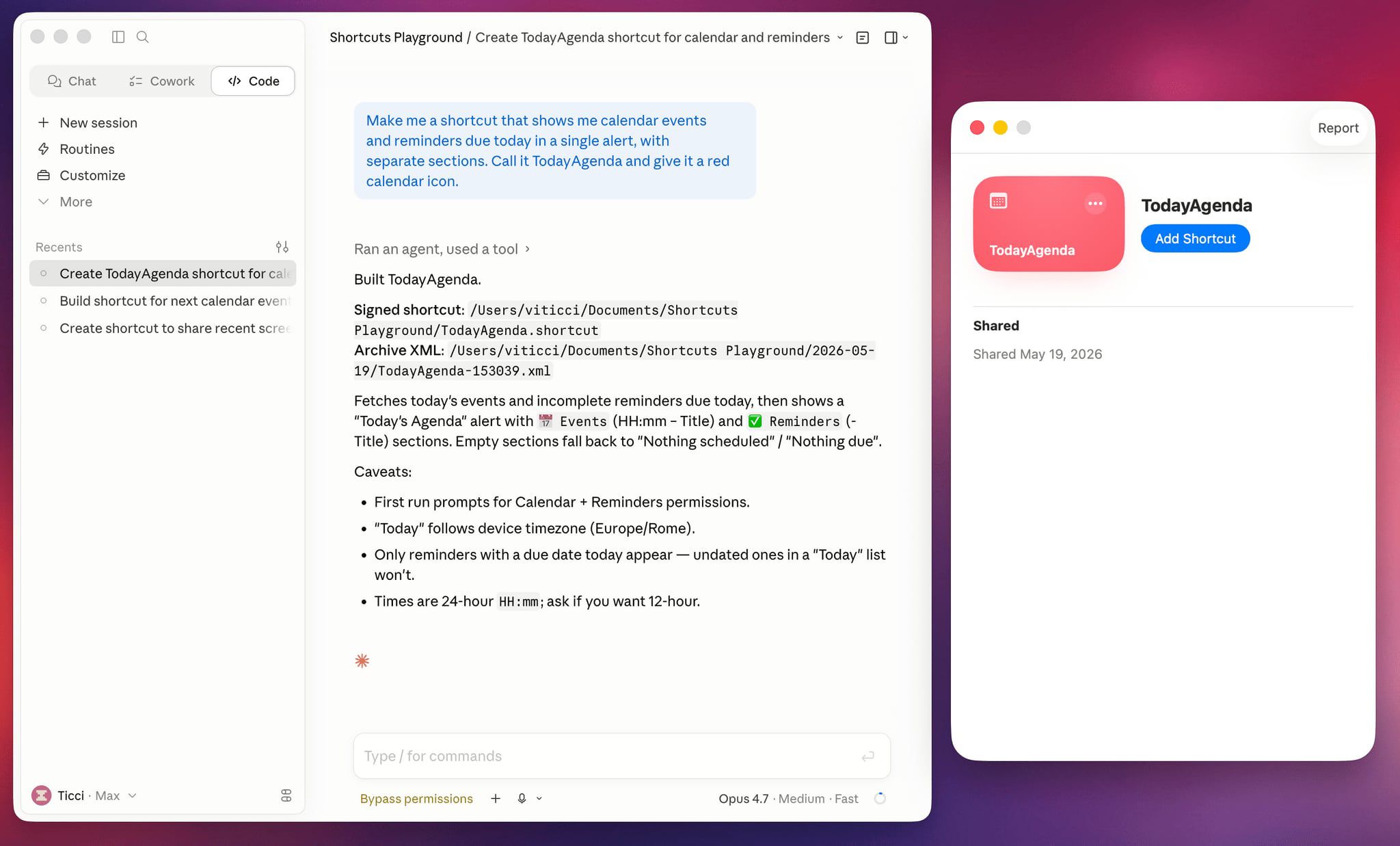
Federico Viticci’s Shortcuts Playground brings natural-language shortcut creation to Apple’s Shortcuts app today via Claude Code and OpenAI Codex, ahead of Apple’s rumored iOS 27 AI feature. The tool is free, open source, and available on GitHub, with examples and documentation already published. While it may accelerate shortcut creation across iPhone, iPad, and Mac, the news is primarily a niche productivity update rather than a market-moving event.
The immediate beneficiary is less Apple’s core hardware demand than its ecosystem lock-in. A credible path to AI-native automation lowers the switching cost for power users and makes iOS/macOS meaningfully stickier, which matters most for installed-base monetization rather than unit growth. The second-order effect is that “good enough” agentic workflow creation becomes a feature race inside productivity platforms, putting pressure on any third-party automation layer that depends on manual scripting or premium no-code tooling.
The bigger implication for AAPL is not near-term revenue, but engagement and platform control over the next 12-24 months. If Apple can ship a native version in iOS 27, it would likely compress the shelf life of standalone automation products and reinforce the narrative that the most valuable AI features are embedded, private, and on-device. That favors Apple’s retention economics but does little for monetization unless paired with a broader upsell into iCloud, device upgrades, or developer services.
Contrarianly, the market may be overestimating how much this changes the earnings story. AI shortcut generation is a power-user feature with limited TAM, and accuracy/QA friction can keep real adoption below headlines. The risk is that Apple telegraphs capability before it is robust enough, which would create a familiar “demo-to-delivery” gap over the next few quarters and cap enthusiasm if the feature feels more experimental than transformative.
For PINC, this is effectively a non-event except as a reminder that healthcare workflows remain under-automated versus consumer tech. The more interesting read-through is that low-friction agentic tooling raises user expectations for instant, natural-language workflow creation across industries, which could gradually widen the gap between software leaders and legacy workflow vendors over the next 1-3 years.
AI-powered research, real-time alerts, and portfolio analytics for institutional investors.
Request DemoOverall Sentiment
mildly positive
Sentiment Score
0.20
Ticker Sentiment
