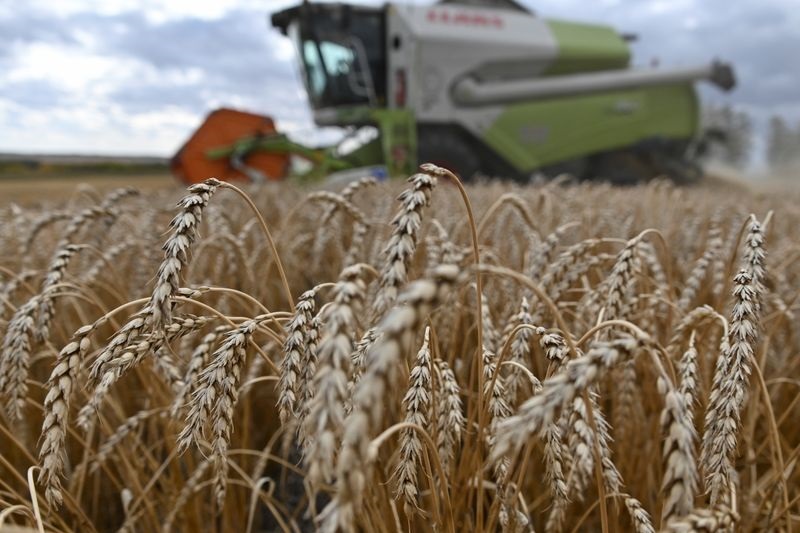
Paris September milling wheat rose 0.8% to €216.75/ton as a weaker euro improved export competitiveness, while Chicago wheat fell 0.9% as traders took profits. Euronext data showed non-commercial participants increased their net long position in milling wheat futures and options for the week ended May 15. The move was driven by currency effects, positioning, and earlier gains tied to China demand expectations and poor U.S. crop ratings.
The key read-through is less about wheat direction than about relative value across origins. A softer euro mechanically improves export competitiveness for European grain just as U.S. weather-driven supply risk is fading into a profit-taking phase, which makes the spread between Paris and Chicago the cleaner expression than outright longs. If that currency move persists, European exporters can defend share even without a fresh bullish demand impulse, while U.S. futures are more vulnerable to mean reversion once speculative length gets crowded.
Positioning matters here: the increase in non-commercial length suggests the market has already pulled forward a meaningful amount of the bullish drought/China narrative. That raises the odds of a fast air-pocket if U.S. crop conditions stabilize or if Chinese purchases disappoint, because commodity longs are highly reflexive when they are built on weather plus geopolitics rather than end-demand confirmation. The second-order effect is that commercial hedgers on the European side may be more willing to sell rallies into a weaker currency regime, capping upside even as the headline price trends higher.
The oil move is a macro release valve for the rest of ags: cheaper energy lowers freight, fertilizer, and drying costs, which is mildly bearish for the broad grain complex with a lag. The Iran negotiation headline also reduces tail-risk pricing in crude, which matters because a sustained pullback in energy can unwind part of the inflation hedge bid that has supported commodities more broadly. In the near term, this makes wheat more sensitive to its own idiosyncratic fundamentals and less supported by cross-commodity beta.
Contrarian takeaway: the market may be overemphasizing the drought narrative in U.S. wheat while underweighting how quickly FX can dominate export competitiveness for Europe. If the euro stays soft and crude stays contained, the best risk-adjusted expression is likely relative rather than directional: long Paris wheat vs short Chicago wheat, with the caveat that any sudden escalation in Black Sea or Middle East geopolitics would flip the trade by reintroducing broad-based risk premia.
AI-powered research, real-time alerts, and portfolio analytics for institutional investors.
Request DemoOverall Sentiment
neutral
Sentiment Score
0.05
