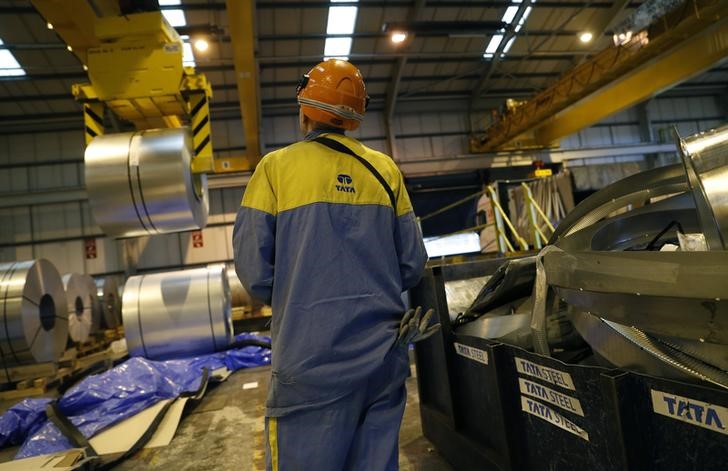
Tata Steel reported FY2026 consolidated EBITDA of INR 34,848 crore, up 35% year over year, with margin expanding to 15% and Q4 EBITDA of INR 9,953 crore at a 16% margin. Management guided to about INR 20,000 crore of FY2027 capex, proposed a INR 4 per share dividend, and highlighted continued cost savings, stronger cash flow, and improving U.K./Netherlands performance. Offseting positives are regulatory uncertainty in the Netherlands, coke-plant closure risk, and some near-term supply-chain and pricing volatility.
The market is still treating this as a basic steel-cycle beat, but the real story is mix migration plus policy optionality. The downstream-heavy strategy is increasingly a margin-defensive franchise, not a pure volume story: if management can keep shifting ounces from commodity flats into branded retail, auto, tubes, wires and packaging, the earnings multiple should behave less like a cyclical mill and more like a quasi-industrial platform. That matters because the biggest incremental value here is not in current EBITDA, but in the dispersion between commodity steel pricing and value-added realizations over the next 4-8 quarters.
Europe is the key second-order lever. The UK policy shift and CBAM-related tightening in Europe improve the earnings floor for local producers, but the bigger effect is that import arbitrage gets structurally worse for third-party exporters, which should support domestic spreads and make internal slab transfers more valuable. The market may be underestimating that Tata’s integrated supply chain can monetize this better than standalone peers: if slab exports and downstream conversion remain exempt/advantaged, the group can capture system-level EBITDA even when local operations look weak on a standalone basis.
The Netherlands uncertainty is being read as a binary operating risk, but the more important issue is capital discipline. A forced remediation/closure path would likely suppress future growth capex rather than destroy the franchise; that can actually be positive for consolidated returns if management redeploys capital to India and logistics. The downside case is timing: if regulators accelerate a shutdown before the transition is fully sequenced, expect a 1-2 quarter margin air pocket, not a thesis break, because the business can source inputs externally and preserve EBITDA-positive status.
Contrarian takeaway: consensus is likely over-focused on headline capex and underweight the fact that Tata’s next leg is about asset consolidation, logistics control and downstream integration, not raw steel tonnage. If India demand merely stays mid-single digit and management executes the downstream mix shift, earnings growth can outpace volume growth even in a softer steel tape.
AI-powered research, real-time alerts, and portfolio analytics for institutional investors.
Request DemoOverall Sentiment
mildly positive
Sentiment Score
0.42
Ticker Sentiment
