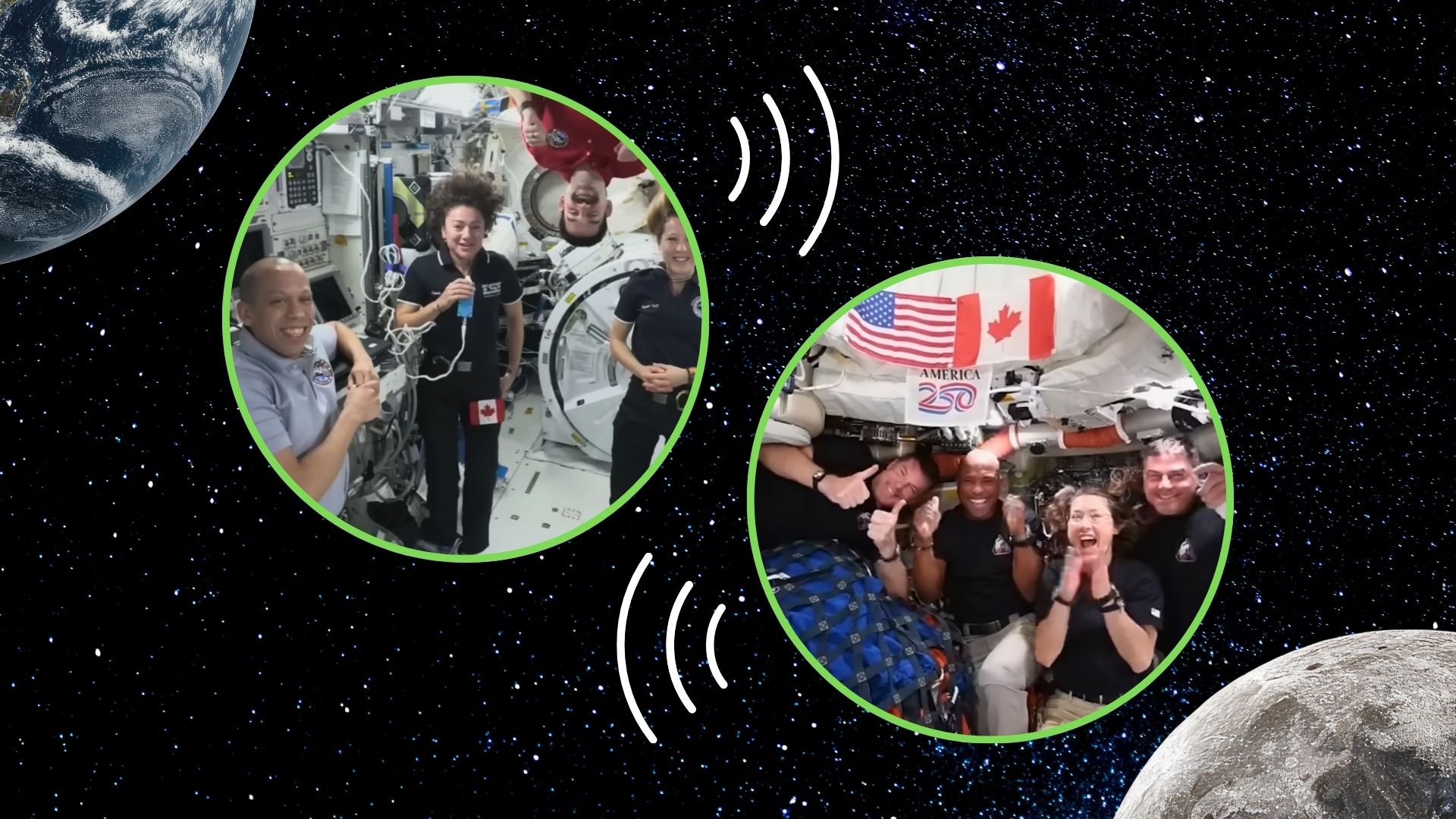
NASA released footage of what it described as the farthest-ever crew call in space, with Artemis 2 astronauts and ISS crew communicating across about 232,141 miles (373,595 km) and later reaching a record furthest distance from Earth of 252,756 miles (406,771 km), surpassing Apollo 13. The article is primarily a human-interest and mission-updates piece highlighting crew operations, training carryover, and intercrew communication rather than any material policy, earnings, or market-moving development.
This is less a media moment than a proof-of-capability signal for the next phase of human-space infrastructure. The meaningful takeaway is that NASA is de-risking deep-space ops by cross-validating procedures, crew coordination, and communications architecture in an environment where latency, spatial constraints, and contingency management are materially harder than LEO. That tends to incrementally improve the probability distribution for lunar mission execution and, by extension, the funding durability of the broader Artemis ecosystem.
The second-order beneficiary set is the industrial and defense supply chain, not the headline-only space names. Any program milestone that reduces perceived execution risk supports budget continuity for avionics, comms, thermal control, propulsion, and ground systems vendors with multi-year backlog exposure. The market usually underprices how much political capital gets preserved when a program demonstrates “operational normality” rather than just technical bravado; that can translate into steadier contract awards over the next 2-4 quarters.
The contrarian point is that this kind of event can be misread as a monetizable commercialization catalyst when it is really a validation step with limited near-term revenue conversion. The upside is mostly in probability-weighted future funding, while the downside is schedule slip risk: any major Artemis delay could quickly unwind sentiment because the market is already assuming a smooth path from demonstration to sustained cadence. So the trade is not “buy space hype”; it is selectively own the picks-and-shovels where recurring government demand is least likely to get repriced away.
For broader portfolios, the biggest overlooked linkage is defense-space convergence. Communications resiliency, autonomous mission ops, and human-rated systems testing all feed the same procurement buckets that support NATO-space, missile warning, and secure satcom budgets. That makes this event mildly constructive for the sector’s long-duration backlog narrative even if it has no immediate earnings impact.
AI-powered research, real-time alerts, and portfolio analytics for institutional investors.
Request TrialOverall Sentiment
neutral
Sentiment Score
0.12
