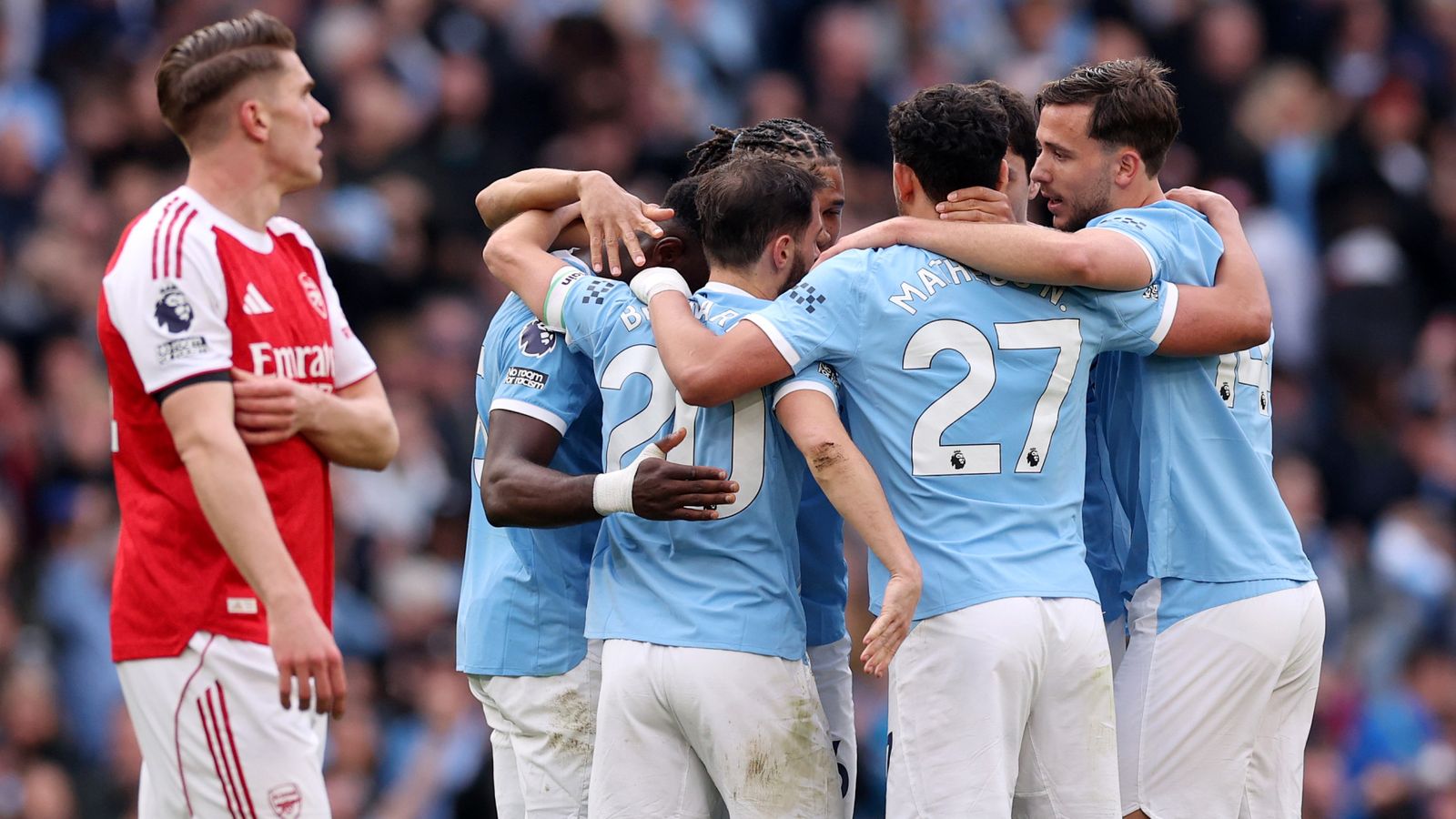
Manchester City beat Arsenal in the top-two Premier League showdown and are now just 3 points behind with a game in hand, meaning a win at Burnley on Wednesday would take them top. The article is primarily a title-race analysis piece, with Guardiola, Arteta, players and pundits weighing in on momentum and mental strength rather than any new financial or company-specific information. Market impact is minimal and the tone is mostly speculative around who will win the league.
The market read-through is less about football and more about narrative control: a single high-visibility event has re-priced probability, urgency, and fan/media engagement around the title outcome. That typically benefits the incumbent favorite’s attention economy in the near term, but the bigger second-order effect is on volatility — every remaining match now becomes an event-driven binary with higher emotional and trading sensitivity, which tends to amplify viewership and engagement metrics for rights holders and sportsbooks.
From a competitive-dynamics lens, the team that just absorbed the loss faces the harsher path: they need near-flawless execution while carrying rising psychological load, and that often shows up first in slower starts, increased defensive caution, and more conservative in-game decision-making over the next 1-2 matches. The other side now has asymmetric optionality: they can force pressure with each result while retaining the right to let the market do the work for them. In a crowded media landscape, that usually means the “comeback” storyline has more incremental monetization than the “leader holds serve” storyline, even if the underlying odds remain finely balanced.
The contrarian miss is that consensus tends to over-interpret one match as trend confirmation when the real driver is schedule leverage. If the chasing side converts the next game into a points tie, the psychological edge can flip back immediately because the remaining runway is short and every dropped point becomes terminal. The tail risk is not just an upset; it’s a draw sequence that preserves uncertainty, which is actually the best outcome for engagement businesses but the worst for anyone attempting to express a clean directional view.
For investors, the cleaner trade is not a broad macro bet but a positioning around volatility in sports-media and betting engagement. The setup favors names exposed to late-season spike usage, while the countertrade is to fade any assumption that the favorite is already priced as a lock — the remaining path is still short enough for a single surprise to reset probabilities materially.
AI-powered research, real-time alerts, and portfolio analytics for institutional investors.
Request DemoOverall Sentiment
neutral
Sentiment Score
0.12
