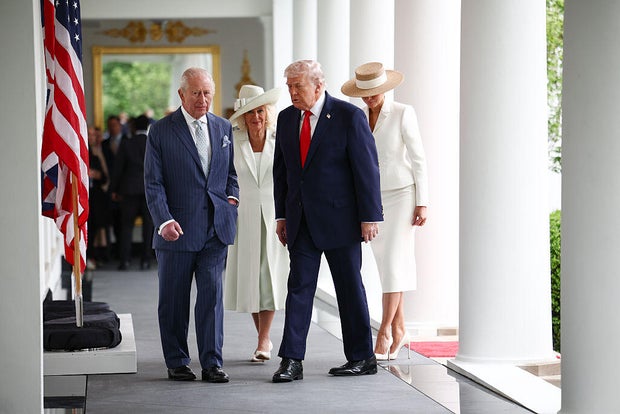
King Charles and Queen Camilla are in Washington for a state visit centered on the 250th anniversary of U.S. independence, including a bilateral Trump meeting, gift exchange, and a 3 p.m. address to a joint meeting of Congress. The visit underscores the U.S.-U.K. "special relationship" and comes amid broader geopolitical discussions, including Iran and international aid, but contains no direct market-moving policy announcement. Near-term financial impact appears limited, with the main significance being diplomatic rather than economic.
This is mostly a signaling event, but the market relevance is in the implicit re-pricing of transatlantic industrial policy. A high-visibility U.S.-U.K. reset lowers the near-term probability of regulatory friction in areas where British platforms are embedded in U.S. procurement and capital markets, while also creating a softer backdrop for cross-border enterprise spending headlines over the next 1-2 quarters. The real second-order effect is reputational: when geopolitics are packaged as ceremonial diplomacy, it usually precedes a series of lower-risk bilateral working groups that can quietly unlock contract awards and approvals.
For AAPL and NVDA, the immediate read-through is not direct revenue, but ecosystem continuity. Both names benefit if U.K. tech and sovereign-supply-chain conversations stay friendly, because it reinforces the narrative that allied-chip, cloud, and AI infrastructure remains the preferred path versus fragmented geopolitical sourcing. The more relevant channel is sentiment: any easing of trade-war language or export-control rhetoric tends to compress risk premiums in mega-cap hardware/software even when fundamentals barely move.
RL is the odd one out and looks mostly incidental. If anything, the luxury signal reinforces that upper-income discretionary demand remains resilient among globally connected consumers, but there is no meaningful company-specific catalyst. The more interesting contrarian angle is that the market may overstate the significance of symbolic diplomacy while underpricing the possibility that thornier issues—defense burden sharing, Ukraine support, or humanitarian aid—surface later and reintroduce policy volatility within weeks to months.
From a timing perspective, the setup is best viewed as a 2-6 week volatility seller rather than a structural alpha event. The upside is modest unless the meetings produce concrete procurement or regulatory language; the downside is a sudden headline break on foreign-policy disputes that could reverse sentiment quickly. So this is more about owning quality beta with tight hedges than making a big directional macro bet.
AI-powered research, real-time alerts, and portfolio analytics for institutional investors.
Request DemoOverall Sentiment
neutral
Sentiment Score
0.05
Ticker Sentiment
