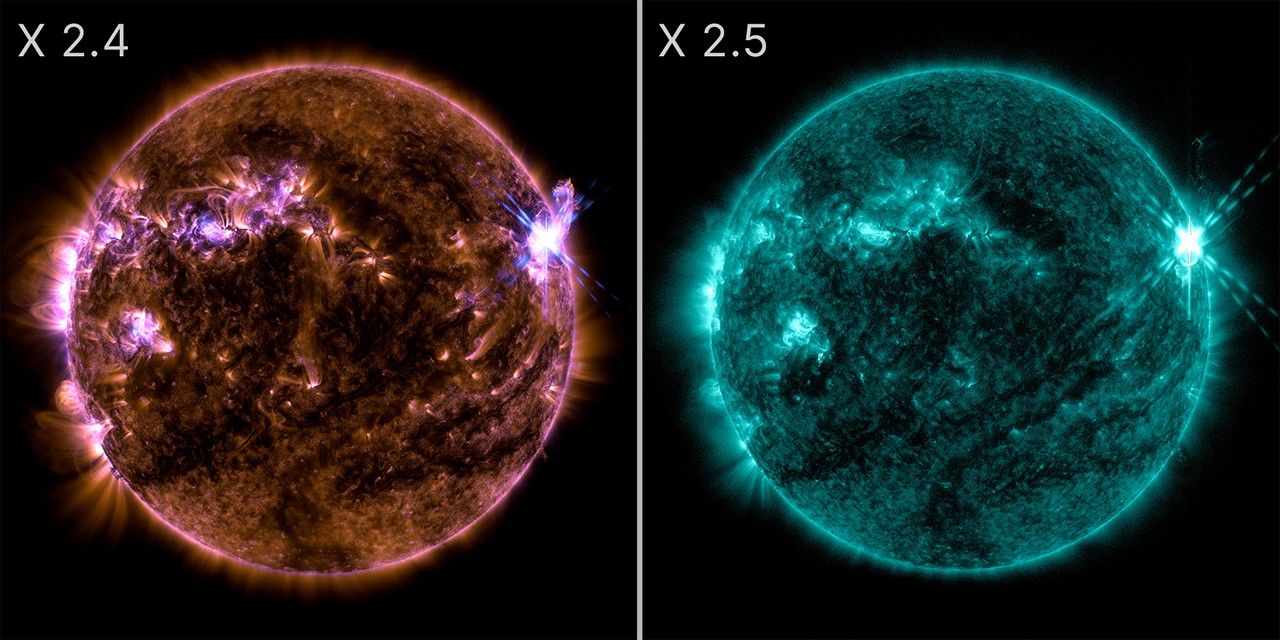
The Sun emitted two strong X-class solar flares, peaking at X2.4 at 9:07 p.m. ET on April 23 and X2.5 at 4:13 a.m. ET on April 24. The flares could disrupt radio communications, electric power grids, navigation signals, and pose risks to spacecraft and astronauts. NASA and NOAA are monitoring the space-weather conditions, but the article is informational rather than market-specific.
This is a short-duration operational risk event more than a fundamental macro shock. The first-order issue is not damage to assets but the possibility of transient degradation in GPS timing, HF radio, satellite telemetry, and grid control systems, which can create localized bottlenecks and volatility in sectors that depend on precise synchronization. In practice, the market impact is usually concentrated in a 24-72 hour window unless a geomagnetic storm is confirmed, so the key is to watch for escalation into a wider space-weather warning rather than trade the flare headlines themselves.
The second-order winners are defense, satellite resilience, grid-hardening, and comms redundancy providers, especially vendors with exposure to mission-critical government and utility budgets. The losers are the most timing-sensitive beneficiaries of uninterrupted navigation and comms: airlines, marine logistics, and high-frequency infrastructure operators if any meaningful disturbance appears. A more subtle effect is that repeated flare events tend to re-rate procurement urgency for backup navigation, hardened chips, and terrestrial fallback systems, which can become a multi-quarter capex tailwind even if the immediate event passes uneventfully.
The contrarian view is that the setup is probably underpriced only if NOAA escalates the forecast; absent that, the market tends to fade these events quickly. The right risk framework is binary: no storm means nothing to monetize beyond a brief volatility blip, but a confirmed geomagnetic impact could drive disproportionate attention to grid vulnerability and satellite uptime. That asymmetry argues for owning cheap optionality in names tied to resilience rather than chasing broad beta.
AI-powered research, real-time alerts, and portfolio analytics for institutional investors.
Request TrialOverall Sentiment
neutral
Sentiment Score
-0.05
