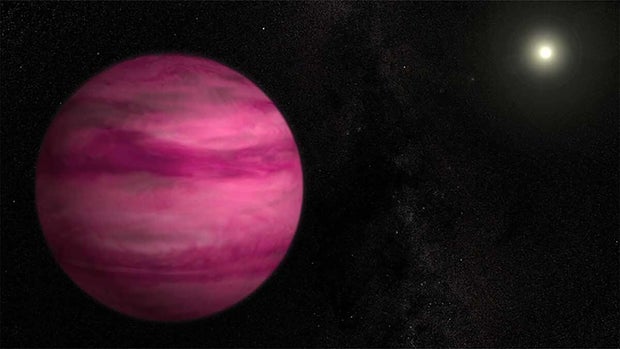
Researchers using the James Webb Space Telescope identified salt clouds in the atmosphere of GJ504b, a 25-Jupiter-mass planetary-mass companion located 57 light-years away and estimated to be 2.5 billion to 4 billion years old. The object has a temperature of about 550 degrees Fahrenheit and its spectrum also showed water vapor, methane, carbon dioxide and ammonia. The finding is scientifically notable but does not appear to have direct market implications.
This is less a one-off astronomy headline than a validation of Webb as a platform that expands the addressable universe of cold/low-luminosity targets. The second-order implication is that the bottleneck in exoplanet characterization is shifting from telescope sensitivity to atmospheric-model quality, which should redirect value toward firms and labs that can turn spectra into interpretable chemistry at scale. In practical terms, any incremental discovery here increases the odds of a new catalog of “cold giant” targets over the next 12-36 months, a regime where ground-based instruments remain structurally disadvantaged.
The competitive dynamic is asymmetric: incumbents in the ground-observation stack do not get displaced, but their edge in marginal discoveries erodes when space-based infrared can resolve objects that are effectively invisible from Earth. That creates a positive feedback loop for follow-on grant funding, mission extensions, and downstream data-processing demand. The more interesting winner is the broader space-enablement ecosystem—detectors, cryogenics, optics, and high-throughput compute—because each new class of target increases utilization and justifies higher spend per observation.
Consensus may underappreciate how quickly this can translate into budget and procurement rather than just scientific prestige. A credible stream of “firsts” from Webb improves the political case for next-generation observatories and raises the expected lifetime value of every successful pointing. The main tail risk is not scientific failure but a slowdown in monetizable follow-through: if discoveries keep coming but without a durable pipeline of targets and analysis tools, the enthusiasm can fade in 6-12 months; if the model generalizes, the cycle can extend for years.
AI-powered research, real-time alerts, and portfolio analytics for institutional investors.
Request DemoOverall Sentiment
neutral
Sentiment Score
0.10
