

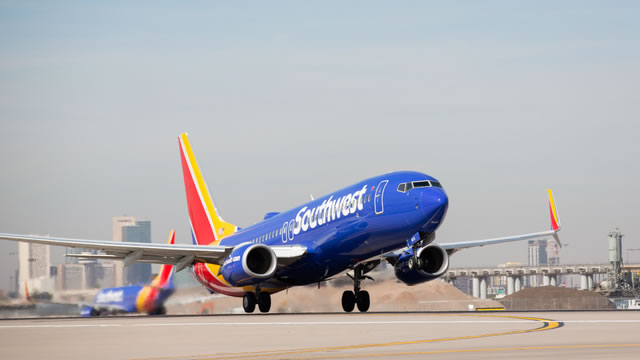
Southwest Airlines (LUV) is reiterated at 'Hold' with a $44/share price target, citing transformation upside but meaningful fuel and execution risk. While 1Q26 results supported cost and fee adoption progress, volatile jet fuel and limited hedging raise risk to full-year EPS goals. Management’s $4/share 2026 EPS guidance looks optimistic; the analyst now estimates $2.9/share after factoring higher jet fuel costs and execution uncertainty.
LUV’s setup is less about one quarter of cost control and more about whether the market is willing to pay for a transformation story before the proof is in the P&L. The key mechanism is convexity to fuel: without a hedge book, every sustained move higher in jet fuel hits earnings almost immediately, while any benefit from fees and process improvements accrues slowly and can be partially offset by demand elasticity. That asymmetry makes consensus EPS vulnerable to revision pressure if energy stays firm, and it also limits the stock’s ability to rerate on “execution” alone.
The competitive implication is that legacy/network carriers with stronger premium mix and richer ancillary revenue streams should hold up better if fuel volatility persists, because they have more levers to offset cost inflation without relying purely on base fares. Relative losers are the lower-margin domestic airlines that need a clean macro backdrop to keep margins expanding. For LUV specifically, the issue is not just absolute cost inflation; it is that management is trying to fund a higher multiple with a business mix that still lacks the pricing power and revenue density of peers.
The near-term catalyst path is 1-3 months: revisions, not headline guidance, will drive the stock. If analysts start cutting 2026 EPS toward the low-$3 range, the current transformation premium can compress quickly. Over 6-18 months, the contrarian risk is that the market is underestimating fee adoption and cost discipline, which could make this an overdone short if fuel rolls over; the thesis is falsified if jet fuel retreats materially and LUV can hold unit revenue while expanding fees, especially into the next earnings cycle.
AI-powered research, real-time alerts, and portfolio analytics for institutional investors.
Overall Sentiment
mildly negative
Sentiment Score
-0.35
Ticker Sentiment
