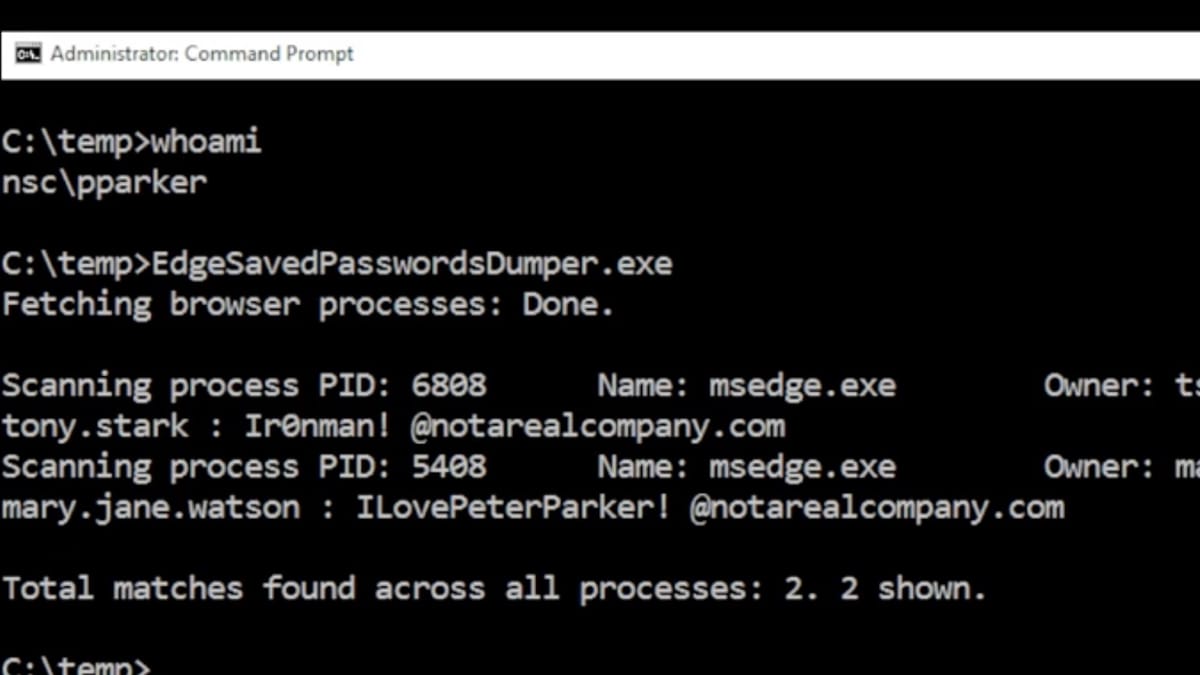
Microsoft Edge was disclosed to decrypt and keep all stored passwords in cleartext process memory from browser launch through the entire session, creating a persistent credential-extraction risk. Microsoft reportedly responded that the behavior is "by design," while Chrome uses on-demand decryption plus App-Bound Encryption to limit exposure. The issue is most material for shared Windows, RDS, and VDI environments, where a single admin compromise can harvest credentials across multiple active sessions.
This is less a product bug than a governance problem: Microsoft has effectively conceded that Edge’s credential model prioritizes convenience over blast-radius containment. The market is likely underpricing the second-order enterprise effect in Windows-heavy estates, where the largest exposure is not a single endpoint but shared-session infrastructure (RDS/VDI, jump hosts, managed admin workstations) that turns one compromised privileged account into a vault-wide harvest. That raises the odds of a policy-driven cleanup cycle inside Microsoft-centric IT shops over the next 1-3 quarters, with browser standardization now becoming a security review item rather than a default.
The competitive read-through is mixed but important. GOOGL should benefit at the margin because Chrome’s on-demand decryption narrows the memory-scrape window and reinforces the narrative that Google has moved faster on browser hardening than Microsoft in this niche. NET is mostly insulated directly, but the broader security-budget implication is positive for vendors selling endpoint detection, PAM, and browser isolation as customers look for compensating controls instead of waiting on a browser redesign.
For MSFT, the direct financial impact is probably small, but the headline risk is asymmetric: any subsequent credential-theft incident in a Windows enterprise that can be tied to this behavior creates litigation, procurement friction, and a fresh round of regulator/CSO scrutiny. The consensus may be overrating how quickly Microsoft can reframe this as “by design” without changing enterprise defaults; once a control is shown to be performative, large customers tend to move first in high-risk segments and only later in the broader install base. Watch for vendor guidance changes, Defender/browser hardening feature announcements, or M365 security bundle tie-ins over the next 30-90 days as the most likely reversal catalysts.
AI-powered research, real-time alerts, and portfolio analytics for institutional investors.
Request DemoOverall Sentiment
moderately negative
Sentiment Score
-0.45
Ticker Sentiment
