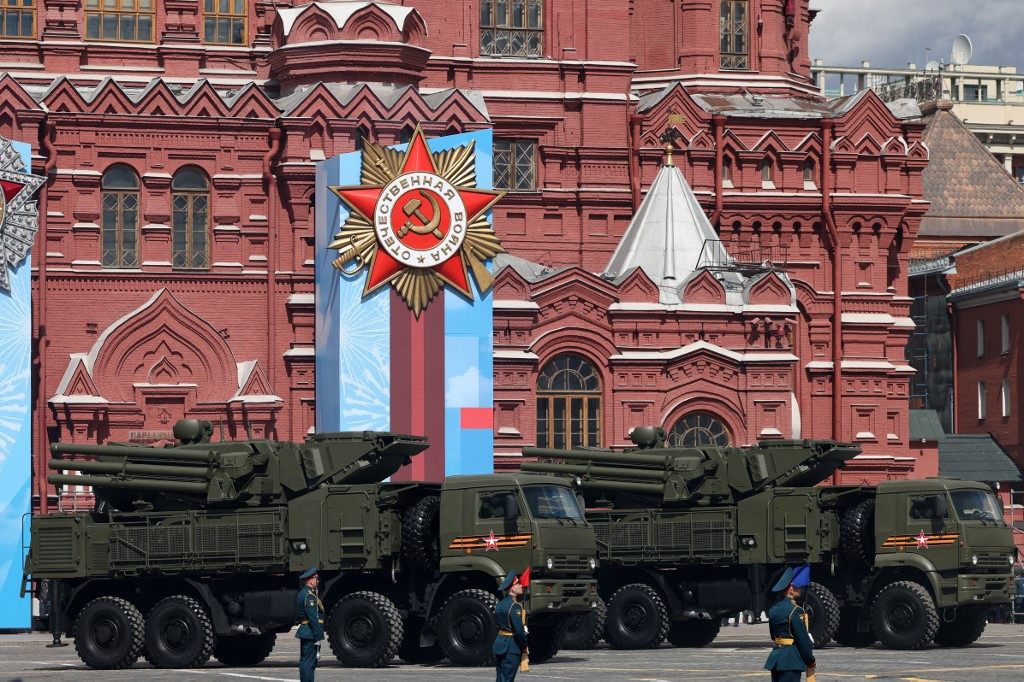
Russia is rapidly expanding air defenses around Moscow, with around 43 new air defense towers installed in 2025 and more than 50 new SAM positions reportedly built since Ukrainian drones first reached the capital in May 2023. The buildup underscores escalating drone threats ahead of the May 9 Victory Day parade, which is expected to proceed without heavy military equipment and under mobile internet restrictions. The Kremlin is also widening authorization for private security firms to use military-grade weapons to protect critical infrastructure from drone attacks, signaling a deeper shift toward wartime defense mobilization.
The key market signal is not the air-defense buildout itself, but the admission that Russia is shifting scarce high-end resources toward point defense of the capital. That implies a growing mismatch between headline defense spending and actual national coverage, with frontline regions and dispersed energy infrastructure increasingly exposed. In practical terms, this raises the probability that Ukraine can sustain a low-cost, high-disruption campaign by forcing Russia to keep expensive interceptors and crews tied up around symbolic assets rather than military-industrial targets.
The second-order effect is attrition economics: interceptor stocks, radar uptime, and trained crew availability become the true bottleneck, not concrete and steel. If Russia is redeploying systems from other districts, the marginal protection of Moscow may come at the cost of lower resilience elsewhere, which can feed through to logistics, refinery uptime, rail nodes, and regional power reliability over the next 1-3 quarters. The added authorization for private security to carry military-grade weapons also suggests the state is broadening internal threat response because it does not trust the military to cover every vulnerable node, a sign of stretched command bandwidth.
The consensus is probably underestimating how much this favors asymmetric warfare and overestimating the deterrent value of visible fortification. More towers do not eliminate the drone problem; they can actually create a false sense of security while concentrating debris risk in dense urban zones and increasing the political cost of any successful breach. The real tail risk is not a single strike, but a sequence of partial penetrations that forces more shutdowns, more internal security spending, and more diversion of assets away from the battlefield.
For investors, the cleaner expression is relative rather than directional: anything tied to Russian regional infrastructure reliability should be approached cautiously, while Western defense names with low-cost drone-countermeasure exposure remain structurally advantaged. The time horizon is months, not days; this is a slow-burn reallocation story unless a high-visibility attack around the parade accelerates budget and procurement shifts. The move looks underpriced if markets still assume static perimeter defense can solve a dynamic drone threat.
AI-powered research, real-time alerts, and portfolio analytics for institutional investors.
Request DemoOverall Sentiment
moderately negative
Sentiment Score
-0.45
