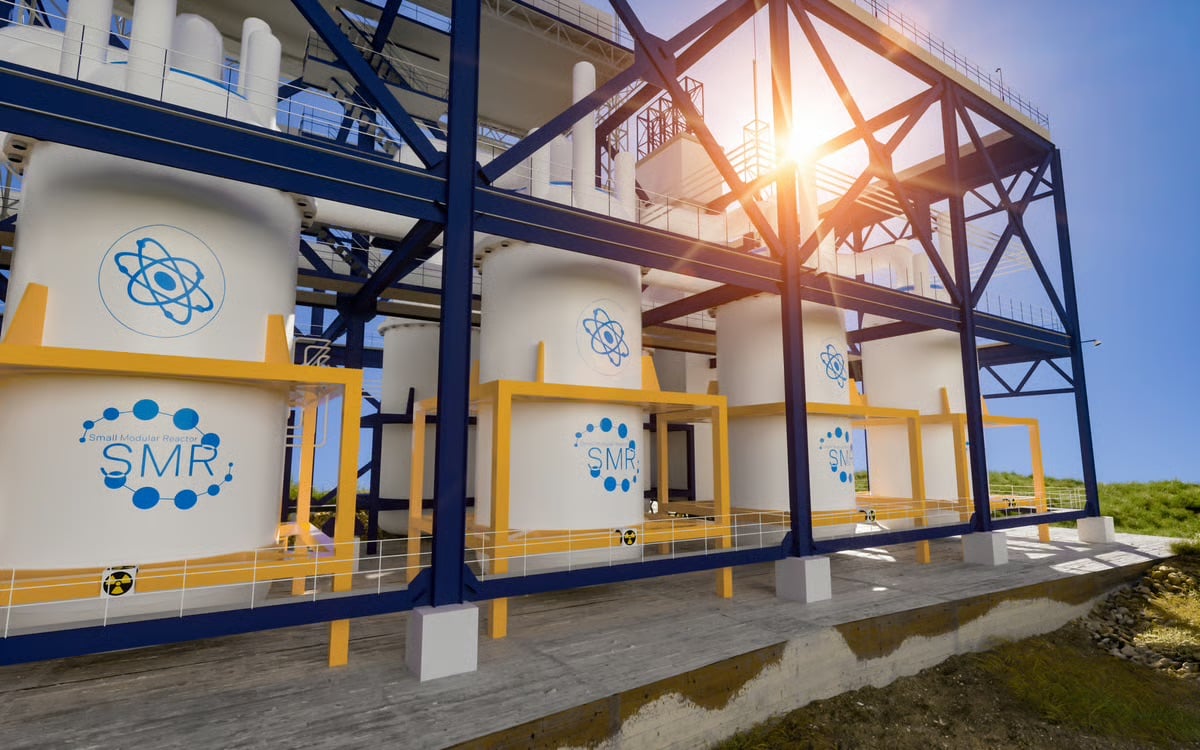
NuScale Power still has no firm sale of its small modular reactor technology, despite progress on a 462-megawatt project in Romania and partnership efforts with TVA for up to 6 gigawatts. The company reported a first-quarter net loss of about $44 million on just $565,000 of revenue, underscoring the gap between commercialization progress and profitability. AI-driven data center power demand is a potential catalyst, but the article remains cautious and says most investors should wait for the first deployment.
The market is increasingly pricing NuScale less as a standalone utility-equipment story and more as an AI infrastructure optionality play, but that framing cuts both ways. If hyperscale data-center power scarcity persists, early mover licensing value could re-rate quickly because the bottleneck is not demand for electrons but deliverability of firm, carbon-free baseload on compressed timelines. The second-order winner is likely not SMR equity holders first, but adjacent industrials with modular nuclear supply exposure, EPC capacity, and grid interconnection equipment that can monetize multiple projects before NuScale proves unit economics.
The bigger issue is that first commercial deployment is a binary credibility event. Until a plant is operating on schedule and within budget, the equity behaves like a capital-intensive venture asset with repeated financing risk, and each delay increases the probability that customers choose established alternatives: gas peakers, long-duration batteries, PPAs with legacy nuclear, or simply relocate data-center capacity to power-rich regions. A successful Romania/TVA milestone would matter less for near-term revenue than for lowering the implied probability of execution failure across the entire pipeline, which is why the stock can gap sharply on non-financial headlines.
The contrarian angle is that consensus may be underestimating how little near-term revenue needs to move for the stock to rerate, but also overestimating how quickly that rerating can sustain. Even a signed deal does not solve financing, permitting, or construction risk; it mainly shifts the story from "technology concept" to "project execution." In that sense, the right trade horizon is months to years, not days, and the asymmetry favors event-driven upside only if the market is willing to pay for narrative scarcity rather than current earnings power.
AI-powered research, real-time alerts, and portfolio analytics for institutional investors.
Request DemoOverall Sentiment
neutral
Sentiment Score
-0.05
Ticker Sentiment
