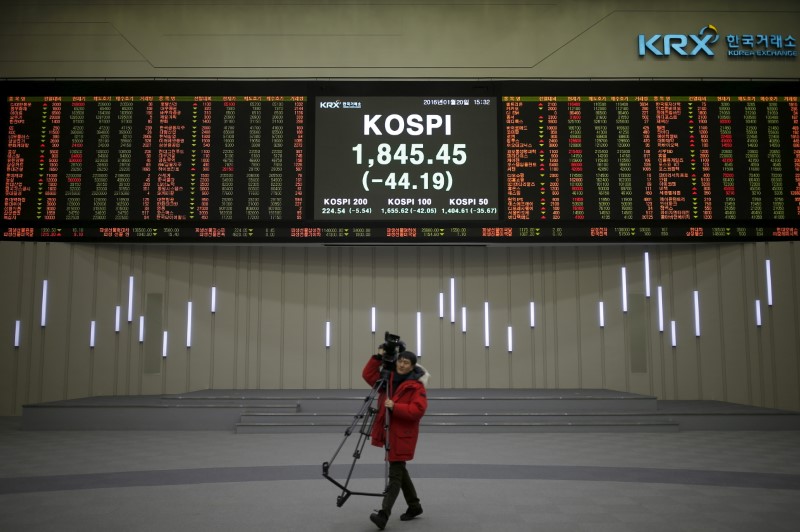
South Korea’s KOSPI fell nearly 6% to 8,621.99 on profit-taking after a record AI-driven rally, briefly triggering a Korea Exchange sidecar curb that halted program trading. Heavyweights SK Hynix and Samsung Electronics dropped 6.6% and 5.4%, while the index was also pressured by reports South Korea will not be added to MSCI’s developed markets index in the upcoming review. Despite the selloff, the KOSPI remains up roughly 78%-83% year-to-date, underscoring how extended positioning and valuation concerns are driving a sharp risk-off reversal.
The key issue is not the size of the pullback; it is how crowded the Korea AI trade became in a very short window. When a benchmark is driven by a small set of semis plus persistent foreign inflows, the first liquidation tends to hit index futures and program baskets before it shows up as fundamental de-rating, which is why the move can overshoot on the downside for 1-3 sessions even if the medium-term story remains intact. The trading halt signals stress in market microstructure, not just sentiment, and that usually widens intraday volatility for several days as systematic flows de-risk.
The MSCI disappointment matters less on the headline than on positioning. A deferred upgrade extends the horizon for passive re-rating, so the market loses a clean, date-specific catalyst that had been easy for foreign buyers to front-run. That creates a vacuum where valuation has to be defended by earnings revisions alone; if those revisions slow, the fastest money exits first. The second-order effect is that any regional EM/Asia allocator who used Korea as a proxy for AI beta may rotate toward Taiwan, Japan equipment names, or direct U.S. AI beneficiaries instead.
The bigger fundamental tension is within the semiconductor complex itself: the market has been pricing scarcity and AI capex growth, but reports of HBM production throttling imply management is prioritizing margin over unit growth. That can be rational for the company, yet it also tells you the revenue growth trajectory may normalize faster than bullish models assume. If investors conclude that HBM is no longer a pure volume story, suppliers tied to packaging, testing, and downstream capex can underperform even if the AI buildout remains intact.
Contrarian take: this is more likely a positioning reset than a regime change. A 5%-6% down day after an 80%+ YTD run often flushes momentum, not long-term holders, and that can create a better entry point once forced selling ends. The risk is a second leg lower if U.S. AI names roll over or if next earnings guidance confirms margin defense over growth; in that case, the correction can extend from days into 4-8 weeks.
AI-powered research, real-time alerts, and portfolio analytics for institutional investors.
Request DemoOverall Sentiment
strongly negative
Sentiment Score
-0.58
Ticker Sentiment
