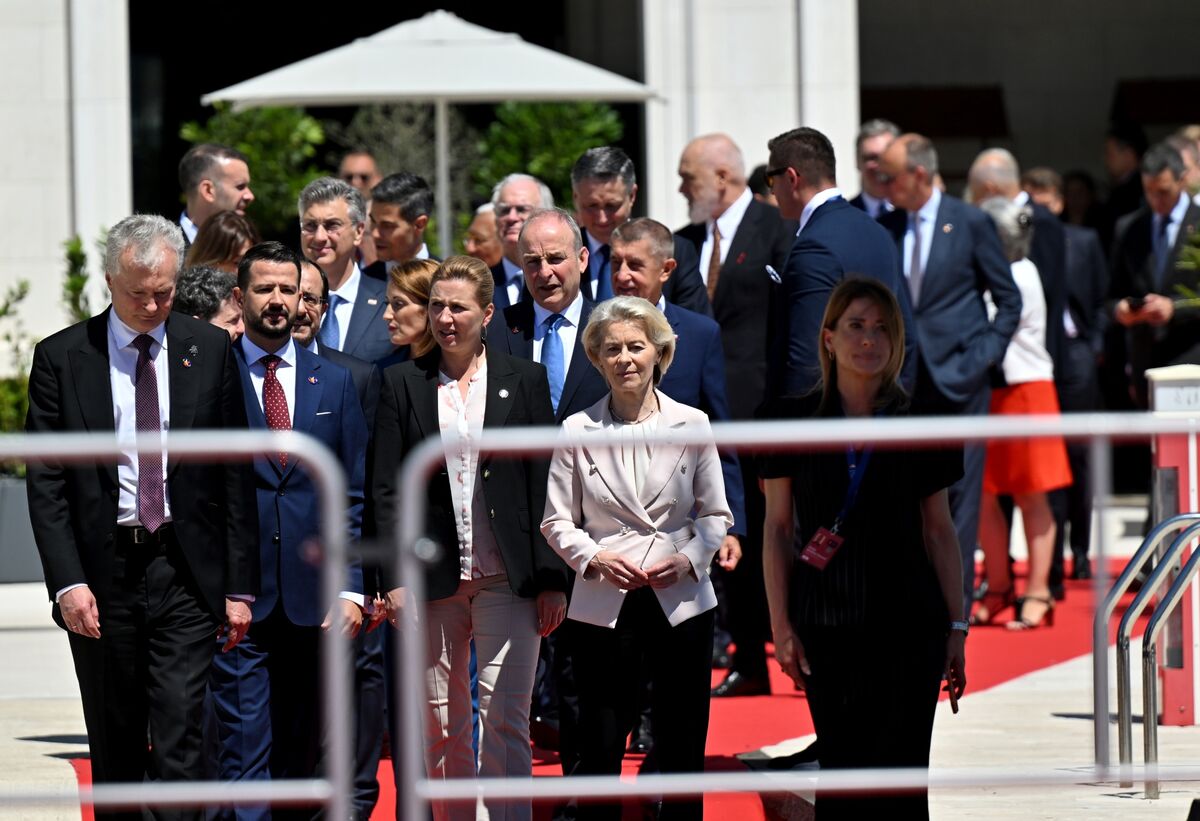
The EU is pushing to revive its stalled enlargement process after 13 years without a new member, citing Russia and China’s growing influence as a strategic threat. Leaders met in Tivat, Montenegro, to signal that expansion remains possible, with Montenegro, Ukraine, and Moldova highlighted as key tests of the bloc’s credibility. The article is primarily geopolitical and institutional, with limited direct near-term market impact.
The market implication is less about immediate accession and more about a re-pricing of political optionality in the EU’s frontier periphery. Even without direct tickers, the first-order winners are the sovereigns and contractors that sit closest to the accession pipeline: they gain a lower discount rate on future EU funds, concession awards, and public-private infrastructure tenders. The second-order winner is European strategic industry, because accession rhetoric is effectively a commitment device for longer-dated spending on transport links, border security, power grids, and dual-use logistics.
The bigger second-order effect is on Russia/China competitive positioning. A credible enlargement path forces local elites to align procurement, standards, and financing with Brussels rather than Beijing’s capital-heavy offer, which is slower but sticks through embedded infrastructure dependencies. That creates a medium-term squeeze on Chinese telecoms, rail, port, and energy contractors in the Balkans and Eastern Europe, while also narrowing Russia’s leverage where energy dependency and political patronage have historically substituted for institutions.
The catalyst path is slow, but the trade is not binary. The risk is a repeat of prior enlargement fatigue: if Brussels signals criteria without money or timelines, frontier markets can rally briefly and then fade as execution risk reasserts. The most important reversal trigger is domestic politics inside core EU members; a more nationalist or fiscally stressed coalition could quickly turn symbolic accession support into procedural delay, which would compress the valuation premium on any beneficiaries within 3-6 months.
The contrarian view is that the market may be underestimating how inflationary and capacity-constrained this process is for Europe itself. Bringing in lower-income, higher-capex members raises near-term budget burdens and can dilute cohesion on trade, agriculture, and labor mobility, which may be a net negative for some incumbent western exporters even as it helps the security narrative. In other words, this is less a clean geopolitics bullish signal than a rotation from “cheap external influence” toward “expensive internal integration.”
AI-powered research, real-time alerts, and portfolio analytics for institutional investors.
Request DemoOverall Sentiment
neutral
Sentiment Score
-0.05
