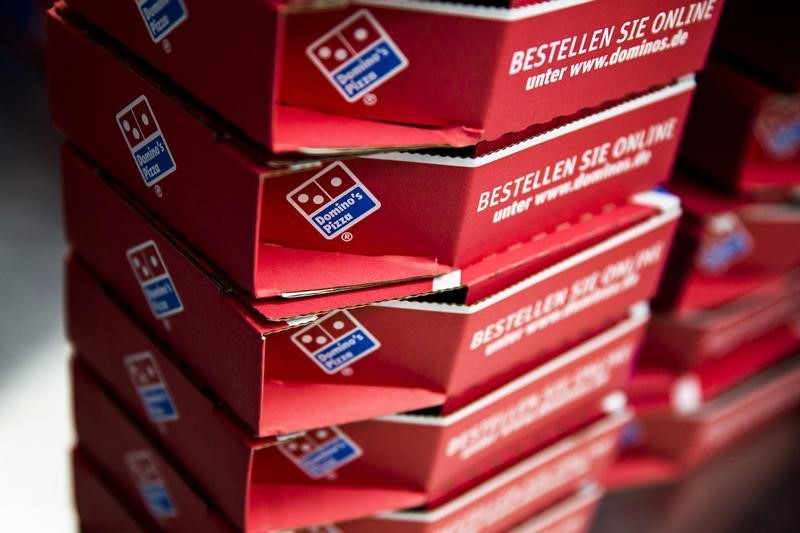
Bernstein SocGen cut Domino’s Pizza’s price target to $390 from $470 and warned that fiscal 2026 expectations have deteriorated after first-quarter results missed consensus EPS at $4.13 vs $4.28. The firm said U.S. share gains failed to materialize, same-store sales underperformed, and fiscal 2026 guidance would leave the company short of its long-term algorithm on a three-year basis. Other brokers also trimmed targets, reflecting broader concern over softer sales, tougher competition, and weaker valuation support.
This is less a one-quarter miss than a reset of the entire self-help narrative. When a mature QSR name stops converting pricing, product, and operational initiatives into incremental comp sales, the market usually re-rates it as a low-growth franchisor rather than a compounder, which compresses the multiple faster than earnings estimates. The key second-order effect is that weaker U.S. traffic makes international and franchisee economics more fragile too, because franchisees are less willing to fund aggressive store-level initiatives when their own unit economics are deteriorating.
The losers are not just DPZ holders; suppliers and local media/marketing vendors tied to transaction growth are exposed to lower same-store sales leverage. Competitors with better value perception and delivery economics can quietly gain share without needing a huge promotional war, especially if consumers are trading down or splitting occasions toward cheaper options. If the softness persists into summer, the market will likely start extrapolating a structurally lower terminal comp base, which would matter more than near-term EPS revisions.
The main catalyst that could reverse sentiment is evidence that comp deceleration was weather/calendar noise rather than demand loss, but that needs to show up quickly in weekly franchisee data or next quarter’s U.S. tickets. Absent that, this is a months-long derating story, not a one-day overreaction. The risk is that a move to defend share with discounts could preserve traffic but destroy margin, making the earnings reset even larger into 2026.
Contrarian angle: the stock may already be pricing in a lot of bad news, so the cleaner short is not outright downside to the low $300s but a failure of multiple expansion from here. If management can still defend unit growth and refranchise economics, the stock may stabilize before fundamentals fully recover, but that requires proof the long-term algorithm remains intact. Until then, the path of least resistance is lower because the market is no longer paying for a premium growth duration story.
AI-powered research, real-time alerts, and portfolio analytics for institutional investors.
Request DemoOverall Sentiment
strongly negative
Sentiment Score
-0.62
Ticker Sentiment
